Scientists find giant ring encircling exotic dead star
May 28, 2008
Scientists find giant ring encircling exotic dead star
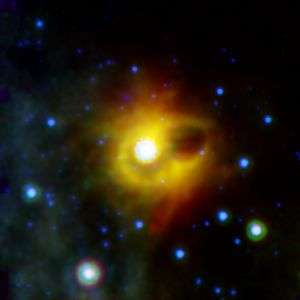
Ghostly Ring—This image shows a ghostly ring extending seven light-years around the corpse of a massive star. The collapsed star, called a magnetar, is located at the exact center of this image. NASA’s Spitzer Space Telescope imaged the mysterious ring around magnetar SGR 1900+14 in infrared light. The magnetar itself is not visible in this image, as it has not been detected at infrared wavelengths (it has been seen in X-ray light). Magnetars are formed when a giant star ends its life in a supernova explosion, leaving behind a super dense neutron star with an incredibly strong magnetic field. The ring seen by Spitzer could not have formed during the original explosion, as any material as close to the star as the ring would have been disrupted by the supernova shock wave. Scientists suspect that the ring my actually be the edges of a bubble that was hollowed out by an explosive burst from the magnetar in 1998. The very bright region near the center of the image is a cluster of young stars, which may be illuminating the inner edge of the bubble, making it look like a ring in projection. This composite image was taken using all three of Spitzer’s science instruments. The blue color represents 3.6-micron infrared light taken by the infrared array camera, green is 16-micron light from the infrared spectrograph, and red is 24-micron radiation from the multiband imaging photometer. Image credit: NASA/JPL-Caltech

One of the most powerful eruptions in the universe might have spun an infrared ring around a rare and exotic star known as a magnetar, a highly magnetized neutron star and the remnant of a brilliant supernova explosion signaling the death throes of a massive star.

A paper published in the May 29 issue of Nature announces the detection of the elliptical ring or shell around the dead star known as SGR 1900+14. Observations obtained from NASA’s Spitzer Space Telescope in 2005 and 2007 suggest the ring was produced by a giant flare originally detected in 1998.

Stefanie Wachter, research scientist at NASA’s Spitzer Science Center at the California Institute of Technology, led the study, which links the origin of the magnetar to a nearby cluster of massive stars, whose light is dominated by two red supergiants at the center.

“Out of 400 billion stars in our galaxy, there are about a dozen magnetars that we know of,” says Donald Figer, professor at Rochester Institute of Technology’s Chester F. Carlson Center for Imaging Science and a co-author of the study. “Discovering the ring is groundbreaking because it discovers some other phenomenon associated with, and physically near, a magnetar. And when you know so little about an object, each new morsel you can gather up is very important.”

Figer is also part of a team, led by Rolf Kudritzki of University of Hawaii, who recently won time on the world’s largest telescope, the W.M. Keck Observatory, to make additional measurements of the magnetar.

“Magnetars possess magnetic fields a million billion times stronger than the magnetic field of the Earth,” Figer says. The magnetic field of a magnetar is one petagauss (10 to the 15th or 1,000,000,000,000,000 gauss) while, in comparison, Earth’s magnetic field strength registers at 0.5 gauss, the Sun at one gauss and a sunspot at about 1,000 gauss. These extreme fields stretch the very fabric of matter, contorting atoms into thin cigar-shaped structures.

An accepted model for magnetars was introduced in the early 1990s to describe the mysterious and frequent flashes of repeating gamma ray emissions first detected in 1979.

The stellar eruption may result from stress induced by the magnetic field dragging on the rapidly spinning star. A fissure in the surface of the magnetar creates a “starquake,” akin to earthquakes. The biggest variety of these eruptions can temporarily produce over a thousand times more energy than all of the stars in a galaxy.

Adds Wachter: “We think that the ring was created when a giant flare from the SGR (soft gamma repeater) carved a cavity into the dusty environment surrounding the magnetar, thus naturally explaining why the ring is centered on the magnetar.”

Wachter’s team also includes Enrico Ramirez-Ruiz from Astronomy and Astrophysics, Vikram V. Dwarkadas from the University of Chicago, Chryssa Kouveliotou from NASA/Marshall Space Flight Center, Jonathan Granot from the University of Hertfordshire, and Sandeep Patel from Optical Sciences Corp.

Source: Rochester Institute of Technology

Explore further: South Africa's new radio telescope reveals giant outbursts from binary star system

add to favorites email to friend print save as pdf

Related Stories

Starquake Reveals Hidden Structure of a Neutron Star

Apr 27, 2006

A US-German team of scientists from the Max Planck Institute for Astrophysics and NASA have used NASA's Rossi X-ray Timing Explorer to estimate the depth of the crust on a neutron star, the densest object known ...

Recommended for you

4C+29.30: Black hole powered jets plow into galaxy

May 15, 2013

(Phys.org) —This composite image of a galaxy illustrates how the intense gravity of a supermassive black hole can be tapped to generate immense power. The image contains X-ray data from NASA's Chandra X-ray ...

A space-time magnifying glass

May 15, 2013

(Phys.org) —Bright arcs are smeared around the heart of galaxy cluster Abell S1077 in this image taken by the NASA/ESA Hubble space telescope. The arcs are stretched images of distant galaxies distorted ...

Orion's hidden fiery ribbon

May 15, 2013

(Phys.org) —This dramatic new image of cosmic clouds in the constellation of Orion reveals what seems to be a fiery ribbon in the sky. This orange glow represents faint light coming from grains of cold ...

User comments : 0

More news stories

Alaska volcano shoots ash 15,000 feet into the air

(AP)—One of Alaska's most restless volcanoes has shot an ash cloud 15,000 feet into the air in an ongoing eruption that has drawn attention from a nearby community but isn't expected to threaten air traffic.

Chinese, Indian airlines face EU pollution fines

Eight Chinese and two Indian airlines face fines of up to several million euros for not paying for their greenhouse gas emissions during flights within the bloc, the European Commission said on Friday.

US seizes Bitcoin operator accounts

US authorities seized the accounts of a Bitcoin digital currency exchange operator, claiming it was functioning as an "unlicensed money service business," court documents showed Friday.

Temporal processing in the olfactory system

The neural machinery underlying our olfactory sense continues to be an enigma for neuroscience. A recent review in Neuron seeks to expand traditional ideas about how neurons in the olfactory bulb might encode information about ...