Antennae Galaxies

May 19, 2008
Antennae Galaxies
Image Credit: NASA, ESA, and the Hubble Heritage Team (STScI/AURA)-ESA/Hubble Collaboration

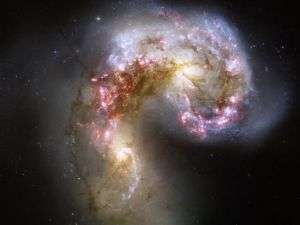
This image of the Antennae galaxies is the sharpest yet of this merging pair of galaxies. During the course of the collision, billions of stars will be formed. The brightest and most compact of these star birth regions are called super star clusters.

The two spiral galaxies started to interact a few hundred million years ago, making the Antennae galaxies one of the nearest and youngest examples of a pair of colliding galaxies.

Nearly half of the faint objects in the Antennae image are young clusters containing tens of thousands of stars. The orange blobs to the left and right of image center are the two cores of the original galaxies and consist mainly of old stars criss-crossed by filaments of dust, which appears brown in the image. The two galaxies are dotted with brilliant blue star-forming regions surrounded by glowing hydrogen gas, appearing in the image in pink.

The new image allows astronomers to better distinguish between the stars and super star clusters created in the collision of two spiral galaxies. By age dating the clusters in the image, astronomers find that only about 10 percent of the newly formed super star clusters in the Antennae will survive beyond the first 10 million years.

The vast majority of the super star clusters formed during this interaction will disperse, with the individual stars becoming part of the smooth background of the galaxy. It is however believed that about a hundred of the most massive clusters will survive to form regular globular clusters, similar to the globular clusters found in our own Milky Way galaxy.

The Antennae galaxies take their name from the long antenna-like "arms" extending far out from the nuclei of the two galaxies, best seen by ground-based telescopes. These "tidal tails" were formed during the initial encounter of the galaxies some 200 to 300 million years ago. They give us a preview of what may happen when our Milky Way galaxy collides with the neighboring Andromeda galaxy in several billion years.

Source: NASA

Explore further: NASA builds unusual testbed for analyzing X-ray navigation technologies

add to favorites email to friend print save as pdf

Related Stories

A space-time magnifying glass

May 15, 2013

(Phys.org) —Bright arcs are smeared around the heart of galaxy cluster Abell S1077 in this image taken by the NASA/ESA Hubble space telescope. The arcs are stretched images of distant galaxies distorted ...

'Space warps' project needs your help

May 08, 2013

(Phys.org) —Astronomers are asking volunteers to help them search for "space warps." More commonly known as "gravitational lenses," these are rare systems with very massive galaxies or clusters of galaxies that bend light ...

Hubble sees a unique cluster: One of the 'hidden 15'

Apr 22, 2013

(Phys.org) —Palomar 2 is part of a group of 15 globulars known as the Palomar clusters. These clusters, as the name suggests, were discovered in survey plates from the first Palomar Observatory Sky Survey ...

Recommended for you

Galaxy's Ring of Fire

May 18, 2013

Johnny Cash may have preferred this galaxy's burning ring of fire to the one he sang about falling into in his popular song. The "starburst ring" seen at center in red and yellow hues is not the product of ...

User comments : 0

More news stories

Power of US tornado dwarfs Hiroshima bomb

Wind, humidity and rainfall combined precisely to create Monday's massive killer tornado in Oklahoma. The awesome amount of energy released dwarfed the power of the atomic bomb that leveled Hiroshima.

NASA's BARREL mission launches 20 balloons

(Phys.org) —In Antarctica in January, 2013 – the summer at the South Pole – scientists released 20 balloons, each eight stories tall, into the air to help answer an enduring space weather question: ...

If you can remember it, you can remember it wrong

(Medical Xpress)—Native peoples in regions where cameras are uncommon sometimes react with caution when their picture is taken. The fear that something must have been stolen from them to create the photo ...