Rice grown in United States contains less-dangerous form of arsenic
May 19, 2008
Rice grown in United States contains less-dangerous form of arsenic
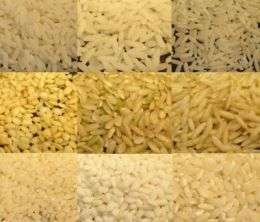
A new study analyzing several types of rice finds that grains grown in the United States may be safer than varieties grown in other countries. Credit: Courtesy of Yamily J. Zavala

Rice grown in the United States may be safer than varieties from Asia and Europe, according to a new global study of the grain that feeds over half of humanity. The study evaluated levels of arsenic, which can be toxic at high levels, in rice worldwide. The two-part report is scheduled for the May 15 issue of ACS’ Environmental Science & Technology.

Yamily J. Zavala and colleagues point out that rice is a potentially important source of human exposure to arsenic, especially in populations with rice-based diets. Arsenic in rice is of special concern because it accumulates in much higher concentrations in rice than other staple grain crops. The researchers discovered that arsenic contamination of irrigation water was more important than soil contamination in increasing arsenic levels in rice.

Using global arsenic data, the researchers classified rice into two types, where the predominant arsenic forms were either organic or the more toxic inorganic forms. They found that rice from the United States largely contains organic arsenic, which is less easily absorbed into the body and excreted more rapidly than inorganic arsenic. Rice contaminated with inorganic arsenic prevails in Asia and Europe.

The study suggests that breeding new rice varieties that convert inorganic arsenic to organic arsenic would be an “important risk reduction strategy, especially for countries like Bangladesh and India with arsenic contaminated environments and high rice consumption rates.”

Source: ACS

Explore further: Farmers plant rice near crippled Fukushima site

add to favorites email to friend print save as pdf

Related Stories

Arsenic exposure could increase diabetes risk

Aug 19, 2008

Inorganic arsenic, commonly found in ground water in certain areas, may increase the risk of developing type 2 diabetes, according to a study by researchers at the Johns Hopkins Bloomberg School of Public Health. The study ...

Recommended for you

Farmers plant rice near crippled Fukushima site

14 hours ago

Farmers have resumed planting rice for market only 15 kilometres (nine miles) from Japan's crippled Fukushima Daiichi nuclear power station, a local official said Wednesday.

Meeting the 'grand challenge' of a sustainable water supply

14 hours ago

Scientists and engineers must join together in a major new effort to educate the public and decision makers on a crisis in providing Earth's people with clean water that looms ahead in the 21st century. That's the focus of ...

Could pond waste be the 'new' fertiliser?

15 hours ago

The University of Stirling is to lead a new project to develop a strategy for using nutrient-rich aquatic biomass waste – from ponds, wetlands and other water-bodies – in farming, as an environmentally ...

Eco database to map landscape projects

15 hours ago

Environmental projects which map some of the most important benefits we get from nature have been brought together for the first time in an online database, following national survey work by researchers in the University ...

User comments : 0

More news stories

Forecast for Titan: Wild weather could be ahead

(Phys.org) —Saturn's moon Titan might be in for some wild weather as it heads into its spring and summer, if two new models are correct. Scientists think that as the seasons change in Titan's northern hemisphere, ...