Chemists measure chilli sauce hotness with nanotubes
May 07, 2008
Chemists measure chilli sauce hotness with nanotubes
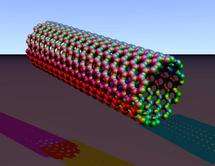
Indispensable in hot kitchens: the nanotube

Oxford chemists have found a way of using carbon nanotubes to judge the heat of chilli sauces. The technology might soon be available commercially as a cheap, disposable sensor for use in the food industry.

Professor Richard Compton and his team at Oxford University have developed a sensitive technique to measure the levels of capsaicinoids, the substances that make chillies hot, in samples of chilli sauce. They report their findings in the Royal Society of Chemistry journal The Analyst.

The current industry procedure is to use a panel of taste-testers, and is highly subjective. Compton’s new method unambiguously determines the precise amount of capsaicinoids, and is not only quicker and cheaper than taste-testers but more reliable for purposes of food standards; tests could be rapidly carried out on the production line.They tested a range of chilli sauces, from the mild 'Tabasco Green Pepper' sauce to 'Mad Dog’s Revenge', which sports an extensive health warning and liability disclaimer.

The well-established Scoville method – currently the industry standard – involves diluting a sample until five trained taste testers cannot detect any heat from the chilli. The number of dilutions is called the Scoville rating; the relatively mild Jalapeño ranges from around 2,500-8,000, whereas the hottest chilli in the world, the 'Naga Jolokia', has a rating of 1,000,000. High performance liquid chromatography (HPLC) can also be used but this requires bulky, expensive equipment and detailed analysis of the capsaicinoids.

In Compton’s method, the capsaicinoids are adsorbed onto multi-walled carbon nanotube (MWCNT) electrodes. The team measures the current change as the capsaicinoids are oxidised by an electrochemical reaction, and this reading can be translated into Scoville units. The technique is called adsorptive stripping voltammetry (ASV), and is a relatively simple electrochemical method.

Professor Compton said: ‘ASV is a fantastic detection technique for capsaicinoids because it’s so simple - it integrates over all of the heat creating constituents because all of the capsaicinoids have essentially the same electrochemical response.’

Professor Compton has applied for a patent on the technology, and Oxford University’s technology transfer subsidiary ISIS Innovation is actively seeking backers to commercialise the technique.

Source: Oxford University

Explore further: Hybrid material as gold-leaf substitute

add to favorites email to friend print save as pdf

Related Stories

Recommended for you

Hybrid material as gold-leaf substitute

22 hours ago

(Phys.org) —A team of researchers headed by Professor Raffaele Mezzenga has created a hybrid material out of gold and milk proteins that looks like a wafer-thin gold leaf. Thanks to its properties, it could ...

Antioxidant with a long shelf life

Jun 17, 2013

(Phys.org) —Scientists from ETH Zurich have developed a nanomaterial that protects other molecules from oxidation. Unlike many such active substances in the past, the ETH-Zurich researchers' antioxidant ...

Fast pollutant degradation by nanosheets

Jun 17, 2013

(Phys.org) —Waste from textile and paint industries often contains organic dyes such as methylene blue as pollutants. Photocatalysis is an efficient means of reducing such pollution, and molybdenum trioxide ...

Unzipped nanotubes unlock potential for batteries

Jun 13, 2013

(Phys.org) —Researchers at Rice University have come up with a new way to boost the efficiency of the ubiquitous lithium ion (LI) battery by employing ribbons of graphene that start as carbon nanotubes.

Nanoparticle opens the door to clean-energy alternatives

Jun 13, 2013

(Phys.org) —Cheaper clean-energy technologies could be made possible thanks to a new discovery. Research team members led by Raymond Schaak, a professor of chemistry at Penn State University, have found ...

User comments : 5

Adjust slider to filter visible comments by rank

Display comments: newest first

E_L_Earnhardt
not rated yet May 07, 2008
Try reading the temperature of cancer cells!
WolfAtTheDoor
5 / 5 (2) May 08, 2008
CNTs are clearly the greatest things ever.
TheBigYin
5 / 5 (1) May 08, 2008
i think PhysOrg should provide a button on the bottom of every article which posts a comment "Is there nothing Carbon nanotubes cannot do?" onthe article to save us typing it.
superhuman
not rated yet May 08, 2008
While carbon nanotubes could prove very useful in various areas they are also extremely hyped so some skepticism is advised. Also there are no comprehensive studies of long term safety and environmental impact data yet and negative results could considerably limit CNT use in consumer products.
photojack
not rated yet May 08, 2008
They would surely prevent some people from getting burned, so to say, from accidentally eating a sauce too hot for their palate. The little chili emblems on menus and jars of hot sauce should be replaced with a scale based on these measurements.

More news stories

3D printing tiny batteries

(Phys.org) —3D printing can now be used to print lithium-ion microbatteries the size of a grain of sand. The printed microbatteries could supply electricity to tiny devices in fields from medicine to communications, ...

Future looks bright for carbon nanotube solar cells

(Phys.org) —In an approach that could challenge silicon as the predominant photovoltaic cell material, University of Wisconsin-Madison materials engineers have developed an inexpensive solar cell that exploits ...

Hybrid material as gold-leaf substitute

(Phys.org) —A team of researchers headed by Professor Raffaele Mezzenga has created a hybrid material out of gold and milk proteins that looks like a wafer-thin gold leaf. Thanks to its properties, it could ...

World's most powerful microscope ready for research

(Phys.org) —The world's most powerful microscope, which resides in a specially constructed room at the University of Victoria, has now been fully assembled and tested, and has a lineup of scientists and businesses eager ...

New Zealand emerges as guinea pig for global tech firms

When Google chose New Zealand to unveil secret plans for a balloon-driven wi-fi network last weekend, it cemented the country's reputation as a test bed for global tech companies looking to trial their latest innovations, ...