CU-Boulder researchers forecast 3-in-5 chance of record low Arctic sea ice in 2008
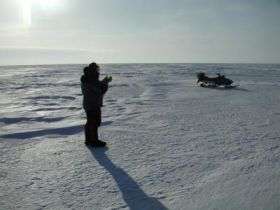
New University of Colorado at Boulder calculations indicate the record low minimum extent of sea ice across the Arctic last September has a three-in-five chance of being shattered again in 2008 because of continued warming temperatures and a preponderance of younger, thinner ice.
The forecast by researchers at CU-Boulder's Colorado Center for Astrodynamics Research is based on satellite data and temperature records and indicates there is a 59 percent chance the annual minimum sea ice record will be broken this fall for the third time in five years. Arctic sea ice declined by roughly 10 percent in the past decade, culminating in a record 2007 minimum ice cover of 1.59 million square miles. That broke the 2005 record by 460,000 miles -- an area the size of Texas and California combined.
"The current Arctic ice cover is thinner and younger than at any previous time in our recorded history, and this sets the stage for rapid melt and a new record low," said Research Associate Sheldon Drobot, who leads CCAR's Arctic Regional Ice Forecasting System group in CU-Boulder's aerospace engineering sciences department. Overall, 63 percent of the Arctic ice cover is younger than average, and only 2 percent is older than average, according to Drobot.
Changes in Arctic sea ice -- defined as the area of an ocean covered by at least 15 percent ice -- is "one of the more compelling and obvious signs of climate change," said Drobot. Continued Arctic sea ice declines likely will have negative effects on various types of wildlife, including polar bears, walruses and seals, he said.
For humans, larger ice-free zones in the Arctic region for longer periods offer potential for cheaper and faster merchant shipping between North America and Europe, he said. The declining ice may well open up the Northwest Passage, for example, which runs through the Bering Strait, the Chukchi Sea, the Beaufort Sea and through the Canadian Archipelago to the Atlantic Ocean.
"Based on the current sea ice conditions, aerospace engineering Research Professor Jim Maslanik said the Northern Sea Route -- the shipping lane from the Atlantic Ocean to the Pacific Ocean along the Russian coastline -- might also open up this summer. "It also is quite possible that extensive ice-free conditions could develop at or near the North Pole," said Maslanik.
CU-Boulder's Arctic Regional Ice Forecasting System group -- the only research group in the world currently making seasonal Arctic sea ice forecasts based on probability -- receives funding from the National Science Foundation, the National Oceanic and Atmospheric Administration and NASA.
In January 2008, a team led by Maslanik and involving CCAR's Drobot, Charles Fowler and William Emery, as well as Julienne Stroeve of CU-Boulder's Cooperative Institute for Research in Environmental Sciences and NASA's Jay Zwally and Donghui Yi, concluded there had been a nearly complete loss of the oldest, thickest Arctic sea ice. The team calculated that 58 percent of the remaining Arctic sea ice was thin and only two to three years old.
The researchers used passive microwave, visible infrared radar and laser altimeter satellite data from NOAA, NASA and the U.S. Department of Defense, as well as ocean buoys to measure and track sections of sea ice. They developed "signatures" of individual ice sections roughly 15 miles square using their thickness, roughness, snow depth and ridge characteristics, tracking them over the seasons and years as they moved around the Arctic.
Last summer the CCAR Arctic Regional Ice Forecasting System group, which has been making Arctic sea ice forecasts for the past six years, correctly forecast the 2007 record minimum. Updated forecasts will be provided throughout the spring and summer. For more information visit the Web at http://ccar.colorado.edu/arifs.
Source: University of Colorado at Boulder


