Simulations may explain nanoparticles 'pinned' to graphene
Apr 24, 2008
Sandia simulations may explain nanoparticles 'pinned' to graphene
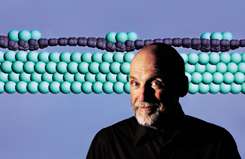
Graphene has proven a difficult material for researchers to tame. Peter Feibelman 's computational simulation suggests an explanation for why iridium atoms (colored green) nest regularly atop a base of graphene (dark-colored atoms) grown over an iridium substrate. Peter’s image of the orderly nanoscopic metallic arrangement may provide insights to other scientists. His paper on the work was published last Thursday in Physical Review B online. (Photo by Randy Montoya)

It was hard to understand how a graphene sheet — a featureless, flat sheet of carbon atoms — lying on an equally featureless iridium surface, somehow converted itself into a kind of muffin tin that formed “muffins” made from newly arrived iridium atoms. The muffins were equally spaced and of equal size.

Graphene flakes are notoriously difficult to work with. Still, they are stronger than diamond, better heat-shedders and conductors than silicon, and thought to have great potential in the worlds of microelectronics and sensors. If only they could be tamed.

Imagining a whole new set of possible applications, people wanted to know why the orderly metallic array self-created itself.

“At the outset,” writes Sandia researcher Peter Feibelman, who created the explanatory simulation published last week in Physical Review B, “this seemed quite a mystery.”

The mystery started in 2005, when a German team discovered the new wrinkle in the battle to harness graphene but had difficulty in explaining the reaction.

A graphene flake lying atop an iridium crystal unexpectedly caused new iridium atoms, deposited atop the flake, to arrange themselves into cluster arrays, stable even as its temperature reached 400 to 500 kelvin.

Sherlock Holmes himself, looking for clues to why the iridium quantum dots so mysteriously attached, would have found little to go on.

The iridium support layer was flat as could be. The same was true of the graphene layer that formed on top of it, which sported neither hooks nor ports for nanoparticle docking.

Graphite itself — merely a group of sheets of graphene — is so slippery it can be used as a lubricant. Why would nanodots attach to the completed graphene layer instead of just sliding away?

Even granted an attachment mechanism, why would newly introduced iridium atoms form a moiré — a regular, ordered array — atop the graphene instead of a planar second surface — a sandwich where the iridium was the bread and graphene the meat?

The explanation for the template effect would be almost impossible to see by direct examination.

But Feibelman’s computational simulations produced a plausible explanation.

The simulation suggest that in regions where half the graphene flake’s carbon atoms sit directly above iridium atoms of the underlying crystal, iridium atoms added on top of the graphene flake make it buckle. These regions do not occur randomly, and in fact form the regular array needed to explain the nanodot moiré.

The buckling weakens tight links between the graphene’s neighboring carbon atoms, freeing them to attach to the added iridium atoms. Furthermore, buckling not only allows the carbon atoms that buckle upward to capture deposited iridium atoms, but also causes the carbon atoms that buckle down to attach firmly to the metal below, explaining the remarkable thermal stability of the nanodot arrays.

This orderly nanoscopic arrangement appeals to scientists trying to understand aspects of catalysis, Feibelman says. The atoms that make up tiny nanodots are expected to be in direct contact with inserted materials, important for speeding up desirable chemical reactions. The regular arrangement of the nanodots makes the science relatively simple, because every catalyst particle is the same and sits in the same environment.

“The rigorous periodicity of the nanodot arrays is a huge advantage compared to amorphous or ‘glassy’ arrangements where everything has to be described statistically,” says Feibelman.

Similar quantum dot arrangements on electrically insulating graphene could keep information packets separate and “addressable” for data storage, or provide superior conditions for quantum computing.

Source: Sandia National Laboratories

Explore further: Tailoring optical processors: Arranging nanoparticles in geometric patterns allows for control of light with light

add to favorites email to friend print save as pdf

Related Stories

Growing geodesic carbon nanodomes

Oct 12, 2009

Researchers analyzing the assembly of graphene (sheets of carbon only one atom thick) on a surface of iridium have found that the sheets grow by first forming tiny carbon domes. The discovery offers new insight ...

Recommended for you

Engineers' nanoantennas improve infrared sensing

May 20, 2013

(Phys.org) —A team of University of Pennsylvania engineers has used a pattern of nanoantennas to develop a new way of turning infrared light into mechanical action, opening the door to more sensitive infrared ...

Stacking 2-D materials produces surprising results

May 16, 2013

(Phys.org) —Graphene has dazzled scientists, ever since its discovery more than a decade ago, with its unequalled electronic properties, its strength and its light weight. But one long-sought goal has proved ...

User comments : 2

Adjust slider to filter visible comments by rank

Display comments: newest first

Arthur_Dent
2 / 5 (2) Apr 25, 2008
I don't know why computer-simulation was required:
a simple overlay of different-sized "marbles" tied-together ( in sheets, the way the spring-stick molecule-models can be done ) would have shown the underlying cause...

Don't people play with physical-models, anymore?

They're MUCH faster than coding-up a molecular-simulation...

Cheers
CaptSpaulding
2.5 / 5 (2) Apr 25, 2008
Arthur, can you show me a way to build a "physical model" that can be automatically adjusted for temperature and pressure, change the nature of a deposition process (sputter, PVD, CVD, etc.), affect the nature of the attractive and repulsive forces of each individual atom (or element) with everything else around it, or work with say 1000 plus atoms at once? This and a whole lot more are why physical models are increasingly problematic in materials related issues. If you can develop a physical model that lets you change all of these parameters on the fly and automatically spit out the coordinates of each and every individual atom once it is done with the rearrangement, please, be my guest, post it up, write a paper on it, and show us, we would love to see it.

More news stories

How gold nanoparticles can help fight ovarian cancer

Positively charged gold nanoparticles are usually toxic to cells, but cancer cells somehow manage to avoid nanoparticle toxicity. Mayo Clinic researchers found out why, and determined how to make the nanoparticles effective ...

Radioactive nanoparticles target cancer cells

Cancers of all types become most deadly when they metastasize and spread tumors throughout the body. Once cancer has reached this stage, it becomes very difficult for doctors to locate and treat the numerous tumors that can ...

If you can remember it, you can remember it wrong

(Medical Xpress)—Native peoples in regions where cameras are uncommon sometimes react with caution when their picture is taken. The fear that something must have been stolen from them to create the photo ...

B vitamins could delay dementia

(Medical Xpress)—Despite spending billions of dollars on research and development, drug companies have been unable to come up with effective treatments for dementia and Alzheimer's Disease (AD). Now, A. ...

Reducing caloric intake delays nerve cell loss

Activating an enzyme known to play a role in the anti-aging benefits of calorie restriction delays the loss of brain cells and preserves cognitive function in mice, according to a study published in the May ...