Grand Canyon may be as old as dinosaurs, says new study
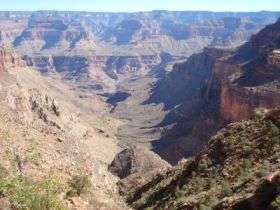
New geological evidence indicates the Grand Canyon may be so old that dinosaurs once lumbered along its rim, according to a study by researchers from the University of Colorado at Boulder and the California Institute of Technology.
The team used a technique known as radiometric dating to show the Grand Canyon may have formed more than 55 million years ago, pushing back its assumed origins by 40 million to 50 million years. The researchers gathered evidence from rocks in the canyon and on surrounding plateaus that were deposited near sea level several hundred million years ago before the region uplifted and eroded to form the canyon.
A paper on the subject will be published in the May issue of the Geological Society of America Bulletin. CU-Boulder geological sciences Assistant Professor Rebecca Flowers, lead author and a former Caltech postdoctoral researcher, collaborated with Caltech geology Professor Brian Wernicke and Caltech geochemistry Professor Kenneth Farley on the study.
"As rocks moved to the surface in the Grand Canyon region, they cooled off," said Flowers. "The cooling history of the rocks allowed us to reconstruct the ancient topography, telling us the Grand Canyon has an older prehistory than many had thought."
The team believes an ancestral Grand Canyon developed in its eastern section about 55 million years ago, later linking with other segments that had evolved separately. "It's a complicated picture because different segments of the canyon appear to have evolved at different times and subsequently were integrated," Flowers said.
The ancient sandstone in the canyon walls contains grains of a phosphate mineral known as apatite -- hosting trace amounts of the radioactive elements uranium and thorium -- which expel helium atoms as they decay, she said. An abundance of the three elements, paired with temperature information from Earth's interior, provided the team a clock of sorts to calculate when the apatite grains were embedded in rock a mile deep -- the approximate depth of the canyon today -- and when they cooled as they neared Earth's surface as a result of erosion.
Apatite samples from the bottom of the Upper Granite Gorge region of the Grand Canyon yield similar dates as samples collected on the nearby plateau, said Caltech's Wernicke. "Because both canyon and plateau samples resided at nearly the same depth beneath the Earth's surface 55 million years ago, a canyon of about the same dimensions of today may have existed at least that far back, and possibly as far back as the time of dinosaurs at the end of the Cretaceous period 65 million years ago."
One of the most surprising results from the study is the evidence showing the adjacent plateaus around the Grand Canyon may have eroded away as swiftly as the Grand Canyon itself, each dropping a mile or more, said Flowers. Small streams on the plateaus appear to have been just as effective at stripping away rock as the ancient Colorado River was at carving the massive canyon.
"If you stand on the rim of the Grand Canyon today, the bottom of the ancestral canyon would have sat over your head, incised into rocks that have since been eroded away," said Flowers. The ancestral Colorado River was likely running in the opposite direction millions of years ago, she said.
When the canyon was formed, it probably looked like a much deeper version of present-day Zion Canyon, which cuts through strata of the Mesozoic era dating from about 250 million to 65 million years ago, Wernicke said. From 28 million to 15 million years ago, a pulse of erosion deepened the already-formed canyon and also scoured surrounding plateaus, stripping off the Mesozoic strata to reveal the Paleozoic rocks visible today, he said.
The prevailing belief is that the canyon was incised by an ancient river about six million years ago as the surrounding plateau began rising from sea level to the current elevation of about 7,000 feet. The new scenario described in the GSA Bulletin by Flowers and her colleagues is consistent with recent evidence by other geologists using radiometric dating techniques indicating the Grand Canyon is significantly older than scientists had long believed.
Source: University of Colorado at Boulder


