The largest synthesized telescope in Europe doubles its surface
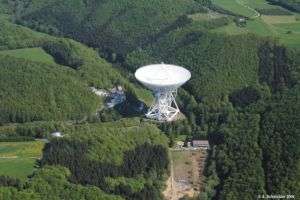
The 100m Radio Telescope Effelsberg enters operations of the e-EVN network, enhancing its sensitivity to detect the radio sky providing the sharpest images in nearby real time. The European radio interferometric network e-EVN almost doubles its sensitivity with the addition of the largest radio telescope in Europe.
With the "First Light" on April 1, 2008, Effelsberg has joined another six radio telescopes spread over Europe with the completion of a 35 km optical fibre link to the information highway, built by the Max Planck Institute for Radio Astronomy. Thus e-EVN becomes not only the fastest radio interferometric network in the world, but also reaches a very high sensitivity to detect extremely faint radio objects in the sky. The operational data link has been funded by the Max Planck Society, in coordination with the programme EXPReS of the European Commission.
This challenging observation mode consists in the joint observations of radio telescopes spread over Europe (Effelsberg in Germany, Cambridge and Jodrell Bank in the UK, Medicina in Italy, Onsala in Sweden, Torun in Poland, and Westerbork in The Netherlands) to synthesize a telescope as large as Western Europe through the connected interferometric technique.
The data are transferred in real time from the different radio telescopes to a super-computer (correlator) in Dwingeloo, the Netherlands, which emulates the Europe-size telescope. The sustained data rate reaches 1 Gigabit per second, which is a factor 500 over the regular private DSL connections. One observing run at this data rate collects 1.5 terabytes of data to produce the sharpest images in astronomy, with resolutions 100 times better than the ESA/NASA Hubble Space Telescope.
Professor Anton Zensus, Director at the Max Planck Institute for Radio Astronomy in Bonn and Chairman of the JIVE Board congratulates the German team that implemented the dedicated high-speed data link for this purpose: "With the support of the Max Planck Society and the EU-funded EXPReS program, we are now, through the participation of the Effelsberg telescope, able to vastly expand the sensitivity of the nascent eVLBI service to a level that makes real astronomical studies with high resolution of short-term variable objects possible."
The optical fibre connecting the Max Planck Institute for Radio Astronomy with the 100m Radio Telescope has 80 single lines. With state of the art techniques and machinery the cable was ploughed or drilled or dug into the ground alongside paths, roads, city streets, crossing fields and even motorways. Many different players in the project, from the different divisions at the MPIfR to the authorities of several city councils, the states of Northrhine Westfalia and Rhineland Palatinade, up to the Federal State and the German Research Network (DFN).
Walter Alef, head of the VLBI Technology Division at the MPIfR, remarks: "The establishment of a high-speed data link between Effelsberg through Bonn, Frankfurt, Amsterdam and from there to Dwingeloo, together with other European telescopes has implied the collaboration of many persons, who have given their best at this complex, cutting-edge technical achievement."
e-VLBI is a technique by which remotely located radio telescopes observe the same region of sky simultaneously, and data from each telescope are sampled and sent to a central processor via high-speed communication networks operating in real-time. This central data processor, a purpose-built supercomputer, decodes, aligns and correlates the data for every possible telescope combination and can generate images of cosmic radio sources with up to a hundred times better resolution than images from the best optical telescopes. EXPReS is developing e-VLBI to replace traditional VLBI's reliance on storing data on high-capacity disk arrays which are shipped to the correlator.
Electronic, real-time VLBI eliminates the shipping of disks and provides astronomers with correlated data in a timely fashion, allowing them to exploit transient astronomical events called Targets of Opportunity.
Source: Max-Planck-Institut für Radioastronomie


