Death of massive star creates brightest burst ever seen
Mar 20, 2008
Record gamma ray burst explosion
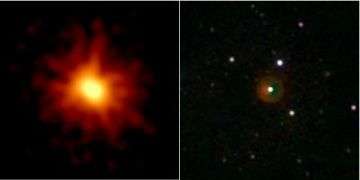
The extremely luminous afterglow of GRB 080319B was imaged by Swift's X-ray Telescope (left) and Optical/Ultraviolet Telescope (right). This was by far the brightest gamma-ray burst afterglow ever seen. Credit: NASA/Swift/Stefan Immler, et al.

Gamma-Ray Bursts are the most powerful explosive events in the Universe. They occur in far-off galaxies and so are usually faint. But on the morning of March 19th 2008 the Swift satellite found a burst which was so bright it could have been seen without binoculars or a telescope even though it was seven thousand times further away than the Andromeda galaxy.

The burst was discovered by the Swift satellite on a fantastic day for GRB hunters. Swift typically finds only two a week; but for the first time Swift found five bursts within 24 hours. The second burst of the day is the new record holder. The enormous energy released in the explosion – brighter than the light from all of the stars in five million Milky Way Galaxies – was caused by the death of a massive star which collapsed to form a black hole.

Dr. Julian Osborne of the University of Leicester, lead investigator for the Swift UK Science Data Centre, said “It’s great to find so many GRBs in one day, and the discovery of the brightest burst ever seen will allow us to explore this incredible explosion in exquisite detail.”

The location of the burst was rapidly pinpointed using the UK-built X-ray and Optical cameras on Swift. Dr. Paul O’Brien, also of the University of Leicester and a member of the Swift Science Team said, “The explosion happened at a distance of over twenty billion light years from Earth. To detect a naked eye object from such a distance really is extraordinary.”

Astronomers around the world are now observing the decaying glow from this burst as it fades away. These include UK teams from the Universities of Leicester, Warwick and Hertfordshire using the Gemini-North Telescope in Hawaii and the Liverpool John Moores University using the Liverpool Telescope on La Palma in the Canary Islands.

Professor Nial Tanvir, of the University of Leicester, said: “Our Gemini observations allowed us to measure the distance to the GRB, and to investigate the behaviour of gas close to the burst as it was blasted by the energy of the explosion”.

Source: University of Leicester

Explore further: South Africa's new radio telescope reveals giant outbursts from binary star system

add to favorites email to friend print save as pdf

Related Stories

Fermi and Swift see 'shockingly bright' burst

May 03, 2013

A record-setting blast of gamma rays from a dying star in a distant galaxy has wowed astronomers around the world. The eruption, which is classified as a gamma-ray burst, or GRB, and designated GRB 130427A, ...

Pulsar jackpot scours old data for new discoveries

Feb 28, 2013

Chalk another one up for Citizen Science.  Earlier this month, researchers announced the discovery of 24 new pulsars. To date, thousands of pulsars have been discovered, but what's truly fascinating abou ...

New candidate for most distant object in universe

May 25, 2011

(PhysOrg.com) -- A gamma-ray burst detected by NASA's Swift satellite in April 2009 has been newly unveiled as a candidate for the most distant object in the universe. At an estimated distance of 13.14 billion ...

Blast from the Past Gives Clues About Early Universe

Oct 28, 2009

(PhysOrg.com) -- Astronomers using the National Science Foundation's Very Large Array (VLA) radio telescope have gained tantalizing insights into the nature of the most distant object ever observed in the ...

Keck Study Sheds New Light on "Dark" Gamma-ray Bursts

Jun 08, 2009

Since its launch in 2004, NASA's Swift has detected more than 430 gamma-ray bursts. Roughly half of them are "dark" bursts that emit little or no visible light. Dense knots of dust in otherwise normal galaxies ...

Recommended for you

Galaxy's Ring of Fire

2 hours ago

Johnny Cash may have preferred this galaxy's burning ring of fire to the one he sang about falling into in his popular song. The "starburst ring" seen at center in red and yellow hues is not the product of ...

4C+29.30: Black hole powered jets plow into galaxy

May 15, 2013

(Phys.org) —This composite image of a galaxy illustrates how the intense gravity of a supermassive black hole can be tapped to generate immense power. The image contains X-ray data from NASA's Chandra X-ray ...

A space-time magnifying glass

May 15, 2013

(Phys.org) —Bright arcs are smeared around the heart of galaxy cluster Abell S1077 in this image taken by the NASA/ESA Hubble space telescope. The arcs are stretched images of distant galaxies distorted ...

User comments : 12

Adjust slider to filter visible comments by rank

Display comments: newest first

drel
4.5 / 5 (2) Mar 20, 2008
%u201CThe explosion happened at a distance of over twenty billion light years from Earth."

"it was seven thousand times further away than the Andromeda galaxy." (2.5 million * 7,000 = 17.5 billion)

So is it 20 Billion or 17.5 billion?

I thought the current estimated age of the universe is 13.7 billion years so how could it be either?

If this GRB is shown to be older than the current estimated age of the universe, is that not an important news story in itself?
franl
1 / 5 (1) Mar 20, 2008
The expansion of the universe makes measuring (and expressing) distances confusing. I found a good explaination at this Web page: http://www.atlaso...ift.html

The gist of the explaination is this: Two galaxies are near to each other when the universe is only 1 billion years old. The first galaxy emits a pulse of light. The second galaxy does not receive the pulse until the universe is 14 billion years old. By this time, the galaxies are separated by about 26 billion light years; the pulse of light has been traveling for 13 billion years; and the view the people receive in the second galaxy is an image of the first galaxy when it was only 1 billion years old and when it was only about 2 billion light years away.
downdiagonal
2.3 / 5 (3) Mar 20, 2008
@drel: Even if the universe was not expanding, you would expect the radius to be 13.7 billion light years and the diameter to be double that: 27.4 billion light years. The universe is expanding, so the starting point of a photon reaching us today after travelling for 13.7 billion years is now 78 billion light years away. The diameter of the universe is 156 billion light years
drel
1 / 5 (1) Mar 20, 2008
ok, i get what your saying, but when (how long ago) did the massive star collapse?
(please don't say on the morning of March 19th 2008 - lol)
enginarc
1 / 5 (2) Mar 20, 2008
ok, i get what your saying, but when (how long ago) did the massive star collapse?
(please don't say on the morning of March 19th 2008 - lol)

good question
fleem
2 / 5 (2) Mar 20, 2008
Erm, no, the %u201CThe explosion happened at a distance of over twenty billion light years from Earth" is simply inconsistent with our current understanding of cosmology. Somebody has made a mistake.
gopher65
2.3 / 5 (3) Mar 20, 2008
No fleem. It is as stated in the posts above. The problem comes because there are multiple ways of specifying distance due to the expansion of the universe. Mainly these three:

1) Original distance between two points when the photon was emitted
2) Current distance between two points as if the universe could be seen from a global frame of reference (that seems what they are using in the article)
3) Current distance between two points as a percentage of the current light radius of the visible universe (13.7 billion light years).

Number 3 is what is normally used, but either of the other two can be used if you are in the mood for funkiness.
dirk_bruere
3 / 5 (1) Mar 20, 2008
How about less handwaving in these reports and some *************NUMBERS*************
Wasara
5 / 5 (1) Mar 20, 2008
Check this NASA link:

http://www.nasa.g...GRB.html

drel
not rated yet Mar 21, 2008
Thank you Wasara. From your provided link the answer is 7.5 Billion years ago.
Ragtime
not rated yet Mar 21, 2008
It would be interesting to compare this event with MAGIC observation, during which the Lorentz symmetry violation has been observed reportedly.

If the theories are correct, then the moment of gamma burst arrival should be quite significantly delayed towards the flash in the visible range.
trantor
5 / 5 (1) Apr 12, 2008
I can just imagine what happened to any living creature in that galaxy, only a a few thousands of light years from this collapsing star.

back in that time, I guess such massive stars were much more common than today... maybe the inhabitants of that galaxy are TODAY watching powerful gamma ray bursts from stars in the Milky Way galaxy... stars that exploded (or imploded) even before the Sun existed. Since the light of such explosions passed by the Sun 7.5 billion years ago, we will never know about them. But aliens living at vast distances will see the Milky Way past.

More news stories

Galaxy's Ring of Fire

Johnny Cash may have preferred this galaxy's burning ring of fire to the one he sang about falling into in his popular song. The "starburst ring" seen at center in red and yellow hues is not the product of ...

Alaska volcano shoots ash 15,000 feet into the air

(AP)—One of Alaska's most restless volcanoes has shot an ash cloud 15,000 feet into the air in an ongoing eruption that has drawn attention from a nearby community but isn't expected to threaten air traffic.

Chinese, Indian airlines face EU pollution fines

Eight Chinese and two Indian airlines face fines of up to several million euros for not paying for their greenhouse gas emissions during flights within the bloc, the European Commission said on Friday.

Morocco to harness the wind in energy hunt

Morocco is ploughing ahead with a programme to boost wind energy production, particularly in the southern Tarfaya region, where Africa's largest wind farm is set to open in 2014.

US psychiatry gets makeover in new manual

The latest makeover to a massive psychiatric tome honored by some, reviled by others and even called the "Bible" of mental disorders is being released Saturday with a host of new changes.