Lemur's Little Finger Poses a Mystery
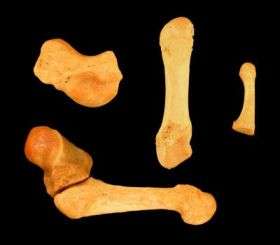
Analysis of the first hand bones belonging to an ancient lemur has revealed a mysterious joint structure that has scientists puzzled.
Pierre Lemelin, an assistant professor of anatomy at the University of Alberta in Edmonton, Canada, and a team of fellow American researchers have analyzed the first hand bones ever found of Hadropithecus stenognathus, a lemur that lived 2,000 years ago.
The bones were discovered in 2003 in a cave in southeastern Madagascar, an island nation off the coast of Africa in the Indian Ocean. Hadropithecus is related to the modern-day sifaka, a type of lemur with acrobatic leaping skills. A lemur is a monkey-like animal with a long tail and large eyes.
An examination of the five tiny hand bones by Lemelin and the rest of the research team revealed a never-before-seen hand joint configuration on the side of the little finger. The same joint configuration is straight in all other primates, including Archaeolemur, a close extinct relative of Hadropithecus.
“Our analysis showed a mosaic of lemurid-like, monkey-like and very unique morphological traits,” Lemelin said. “Because the joint was present on both hands, it’s likely not an anomaly, but because there are no other Hadropithecus hand bones for comparison, we don’t know for certain,” Lemelin said. “It is a mystery, and further investigation is needed to explain the difference in this species.”
Lemelin and his colleagues from George Washington University, the Medical College of Georgia, and the universities of Stony Brook and Massachusetts at Amherst, also discovered that, unlike its close living relatives, Hadropithecus lacked anatomical traits linked with wrist mobility and strong finger flexion that characterize primate species that climb or cling to trees.
The hand bones also showed that Hadropithecus had very short thumbs and was a quadrupedal species, walking on all fours, much like many primates, such as baboons, do today. The discovery underscores the amazing diversity of lemurs that existed more than 2,000 years ago, when lemurs of all types ranged from pocket-sized to the size of gorillas, Lemelin noted.
The findings were published this month in the Journal of Human Evolution.
Source: University of Alberta


