Envisat makes first ever observation of regionally elevated CO2 from manmade emissions
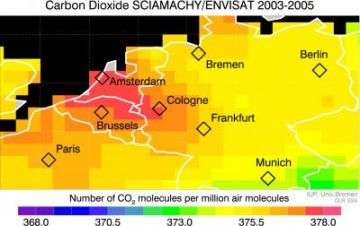
Using data from the SCIAMACHY instrument aboard ESA's Envisat environmental satellite, scientists have for the first time detected regionally elevated atmospheric carbon dioxide – the most important greenhouse gas that contributes to global warming – originating from manmade emissions.
More than 30 billion tonnes of extra carbon dioxide (CO2) is released into the atmosphere annually by human activities, mainly through the burning of fossil fuels.
According to the latest report by the Intergovernmental Panel on Climate Change (IPCC), this increase is predicted to result in a warmer climate with rising sea levels and an increase of extreme weather conditions. Predicting future atmospheric CO2 levels requires an increase in our understanding of carbon fluxes.
Dr Michael Buchwitz from the Institute of Environmental Physics (IUP) at the University of Bremen in Germany and his colleagues detected the relatively weak atmospheric CO2 signal arising from regional ‘anthropogenic’, or manmade, CO2 emissions over Europe by processing and analysing SCIAMACHY data from 2003 to 2005.
As illustrated in the image, the findings show an extended plume over Europe’s most populated area, the region from Amsterdam in the Netherlands to Frankfurt, Germany.
Carbon dioxide emissions occur naturally as well as being created through human activities, like the burning of fossil fuels (oil, coal, gas) for power generation, industry and traffic.
"The natural CO2 fluxes between the atmosphere and the Earth’s surface are typically much larger than the CO2 fluxes arising from manmade CO2 emissions, making the detection of regional anthropogenic CO2 emission signals quite difficult," Buchwitz explained.
"This does not mean, however, that the anthropogenic fluxes are of minor importance. In fact, the opposite is true because the manmade fluxes are only going in one direction whereas the natural fluxes operate in both directions, taking up atmospheric CO2 when plants grow, but releasing most or all of it again later when the plants decay. This results in higher atmospheric CO2 concentrations in the first half of a year followed by lower CO2 during the second half of a year with a minimum around August.
"That we are able to detect regionally elevated CO2 over Europe shows the high quality of the SCIAMACHY CO2 measurements."
Buchwitz says further analysis is required in order to draw quantitative conclusions in terms of CO2 emissions. "We verified that the CO2 spatial pattern that we measure correlates well with current CO2 emission databases and population density but more studies are needed before definitive quantitative conclusions concerning CO2 emissions can be drawn."
Significant gaps remain in the knowledge of carbon dioxide’s sources, such as fires, volcanic activity and the respiration of living organisms, and its natural sinks, such as the land and ocean.
"We know that about half of the CO2 emitted by mankind each year is taken up by natural sinks on land and in the oceans. We do not know, however, where exactly these important sinks are and to what extent they take up the CO2 we are emitting, i.e., how strong they are.
"We also don’t know how these sinks will respond to a changing climate. It is even possible that some of these sinks will saturate or turn into a CO2 source in the future. With our satellite measurements we hope to be able to provide answers to questions like this in order to make reliable predictions," Buchwitz said.
By better understanding all of the parameters involved in the carbon cycle, scientists can better predict climate change as well as better monitor international treaties aimed at reducing greenhouse gas emissions, such as the Kyoto Protocol which addresses the reduction of six greenhouse gases.
Last year, European Union leaders highlighted the importance of cutting emissions from these manmade gases by endorsing binding targets to cut greenhouse gases by at least 20 percent from 1990 levels by 2020.
Source: European Space Agency


