Microneedles Could Replace Syringe
Mar 10, 2008
Microneedles Could Replace Syringe
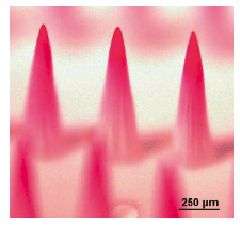
Side view of PVP polymer microneedles with sulforhodamine encapsulated within microneedles. Each microneedle measures 750 µm in height, 250 µm in base diameter, and 5 µm in tip radius. Credit: Advanced Materials, 2008.

The common needle phobia and painful injections could soon be a thing of the past, thanks to a revolutionary new drug-delivery technique developed by a team at the Georgia Institute of Technology, US. The long-practiced method of drug administration has up to now involved the use of hypodermic needles but they have many drawbacks, including pain, risk of infection, and the need for trained staff to perform the injection.

The very few non-invasive methods of drug delivery, such as the transdermal patch, best known in its role as the smokers' nicotine patch, are unsuitable for most drugs as only very small molecules can be transported across intact skin, which excludes the large biotherapeutic molecules found in many medicines.

But what if there was another way, one that was as safe and painless as a patch but as fast and effective as an injection? In a revolutionary new study published in this month's Advanced Materials, the researchers at Georgia Tech. have designed tiny "microneedles", only five micrometers wide at the tip, which can quickly and painlessly deliver drugs into the body and are as effective as a hypodermic.

The drug, in the form of biomolecules, is encapsulated within the microneedles, which are then inserted into the skin in the same way that nicotine is released into the bloodstream from a patch. The needles dissolve within minutes, releasing the trapped cargo at the intended delivery site. They do not need to be removed and no dangerous or biohazardous substance is left behind on the skin.

The researchers chose the mechanically strong polymer poly(vinyl pyrrolidone) (PVP) to fabricate the microneedles because it is robust enough to pierce the skin, dissolves quickly, and is harmless to the body. The molding technique used to prepare the needles means that the rate at which they dissolve can be precisely tuned, depending on how much time is needed for them to travel through the body to the delivery site.

This innovative new treatment method means that vaccines, proteins, and hormones could soon be delivered into the body as effortlessly and painlessly as wearing a plaster. So could needle phobia soon be a thing of the past?

"We expect that microneedles will be able to replace hypodermic needles in some scenarios, but certainly not all cases," said Dr. Mark Prausnitz, who headed up the research. "They won't be useful for withdrawing significant quantities of blood for analysis, for example."

However, the team does expect that the microneedles will have important medical and biotechnology applications. "They are a useful way to deliver vaccines," explained Prausnitz. "Microneedles could possibly enable self-administration of the annual flu vaccine and a number of drugs, including insulin and growth hormone."

Article information: Advanced Materials, 2008, 20, 933; doi: 10.1002/adma.200701205

Source: by Sophie Ladden, Wiley

Explore further: Promising doped zirconia

add to favorites email to friend print save as pdf

Related Stories

New pump created for microneedle drug-delivery patch

Sep 01, 2010

(PhysOrg.com) -- Purdue University researchers have developed a new type of pump for drug-delivery patches that might use arrays of "microneedles" to deliver a wider range of medications than now possible ...

Microneedles enhance drug administration through skin

Feb 04, 2008

In what is believed to be the first peer-reviewed study of its kind involving human subjects, researchers at the University of Kentucky College of Pharmacy and the Georgia Institute of Technology have demonstrated ...

Recommended for you

Competition in the quantum world

2 hours ago

Innsbruck physicists led by Rainer Blatt and Peter Zoller experimentally gained a deep insight into the nature of quantum mechanical phase transitions. They are the first scientists that simulated the competition ...

Promising doped zirconia

May 17, 2013

Materials belonging to the family of dilute magnetic oxides (DMOs)—an oxide-based variant of the dilute magnetic semiconductors—are good candidates for spintronics applications. This is the object of ...

Bringing life into focus

May 17, 2013

Spinning-disk confocal microscopy is an optical imaging technique that can be used to generate detailed three-dimensional fluorescence images of living cells and their contents. Although a powerful tool for ...

User comments : 3

Adjust slider to filter visible comments by rank

Display comments: newest first

sheber
not rated yet Mar 10, 2008
Finally, the 21st century may see an end to the sadistic practice of shoving several large needles into babies thighs!!!
googleplex
not rated yet Mar 11, 2008
Ditto.
PVP appears to be safe so long as it's pure and not de-polymerized back to its monomer. The monomer is very bad. http://en.wikiped...povidone
weewilly
not rated yet Mar 11, 2008
This scares me when you think about what has happened in a mighty big way in Las Vegas recently. How will any patient ever know if it is safe and germ free??? Will it be an improvement or will this be a source of worry for us as short cuts are used by our long trusted Medical professionals. Some trust huh?

More news stories

Competition in the quantum world

Innsbruck physicists led by Rainer Blatt and Peter Zoller experimentally gained a deep insight into the nature of quantum mechanical phase transitions. They are the first scientists that simulated the competition ...

New principle may help explain why nature is quantum

Like small children, scientists are always asking the question 'why?'. One question they've yet to answer is why nature picked quantum physics, in all its weird glory, as a sensible way to behave. Researchers ...

Engineers' nanoantennas improve infrared sensing

(Phys.org) —A team of University of Pennsylvania engineers has used a pattern of nanoantennas to develop a new way of turning infrared light into mechanical action, opening the door to more sensitive infrared ...

Mapping a route to stem cell therapies

Monash University researchers are shedding light on the complex processes that underpin the creation and differentiation of stem cells, bringing closer the promise of 'miracle' therapies.

Lymphatic fluid takes detour

When tumours metastasise, they can block lymphatic vessels, as researchers from ETH Zurich have discovered using a new method. The lymphatic fluid subsequently has to find a new path through the tissue. Such ...

Tiny ancient bandicoot shines light on future

(Phys.org) —A 20 million-year-old fossil skull identified as a 'pocket-sized' ancestor of the bandicoot will give insights into the future of Australia's modern endangered animals.