Endeavour 'Go' For Launch on March 11
Feb 29, 2008
Endeavour 'Go' For Launch on March 11
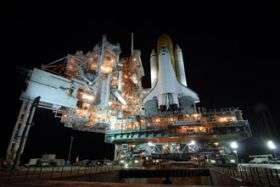
Space shuttle Endeavour has been undergoing launch preparations since it was moved to the launch pad on Feb. 11. Photo credit: NASA/Amanda Diller

NASA's mission management team decided Friday that March 11 at 2:28 a.m. EDT is the official launch time for space shuttle Endeavour's STS-123 mission.

After two days of evaluating launch preparations for the mission, the group has confirmed the readiness of the shuttle, flight crew and payload for the next flight to the International Space Station.

Bill Gerstenmaier, associate administrator for Space Operations said there are very few issues being worked and the shuttle is ready to go. He stressed the16-day mission will be complex for the crew with five spacewalks to continue expansion of the station.

"It was a very thorough review, we covered lots information, lots of data," said Gerstenmaier. "The teams are truly ready."

"It’s a tribute to the teams that they worked so well with the vehicle... they've done a phenomenal job."

"We're right on the timeline," said Mike Leinbach, space shuttle launch director. "Endeavour is doing really well and we're ready to launch on the eleventh."

The crew will deliver the first segment of a Japanese laboratory complex called Kibo, plus a new Canadian robotics system to complement the station's robot arm.

The flight is commanded by Dominic Gorie with Gregory H. Johnson serving as Pilot. The crew also includes Mission Specialists Rick Linnehan, Robert L. Behnken, Mike Foreman, Garret Reisman and Japanese astronaut Takao Doi.

Source: NASA

Explore further: Communications satellite launched into space

add to favorites email to friend print save as pdf

Related Stories

Robotic refueling mission practices new tasks

May 13, 2013

(Phys.org) —With a historic robotic refueling demo ticked off its checklist, NASA's Robotic Refueling Mission (RRM) put down the hose and picked up the screwdriver and utility knife. This latest round of ...

Scientists seek to corral asteroid for study

May 13, 2013

Scheming to rearrange the heavens, scientists are busy planning how to pluck, push and park a spinning asteroid between here and the moon. While most of us hope to dodge space rocks, NASA has unveiled an ambitious, $105 million ...

Landing is key puzzle in Mars trip, experts say

May 08, 2013

Landing astronauts safely on Mars is one of the biggest technological hurdles for any future manned mission to the Red Planet, even more complicated than last year's daring rover touchdown.

Against-the-clock rehearsal for Station immunology test

Apr 25, 2013

Simply getting anything into space is tough, but doing so against a strict deadline can be really stressful. Researchers in an ESA laboratory nervously checked the clock as they extracted immune cells – ...

Recommended for you

Dark, massive asteroid to fly by Earth on May 31

May 24, 2013

It's 1.7 miles long. Its surface is covered in a sticky black substance similar to the gunk at the bottom of a barbecue. If it impacted Earth it would probably result in global extinction. Good thing it is ...

Research team explains 'Lazarus' comets

May 24, 2013

Astronomers from the University of Antioquia have discovered a graveyard of comets. These once-dormant comets, dubbed by astronomers as "The Lazarus comets," are now rejuvenated.

NASA ships sensors for seafaring satellite to France

May 24, 2013

(Phys.org) —Three NASA-built instruments that are integral components of the next in a series of U.S./European ocean altimetry satellites have arrived in France for integration with their spacecraft in ...

Trip into space with DiCaprio costs $1.55m

May 24, 2013

Leonardo DiCaprio is going to get closer to stars of a different kind as he heads into space aboard the Virgin Galactic, and a well-heeled bidder at the Cannes Film Festival has paid 1.2 million euros (1.5 million) to be ...

User comments : 0

More news stories

Galaxies fed by funnels of fuel

(Phys.org) —Computer simulations of galaxies growing over billions of years have revealed a likely scenario for how they feed: a cosmic version of swirly straws.

Century-old science helps confirm global warming

(Phys.org) —Ocean measurements taken more than 135 years ago during the scientific expedition of HMS Challenger have provided further confirmation of human-produced global warming over the past century.