NASA Team Demonstrates Robot Technology For Moon Exploration
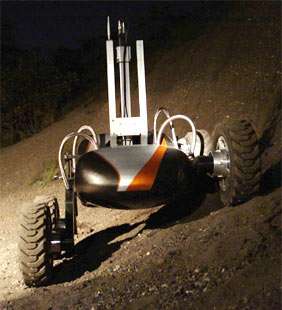
During the 3rd Space Exploration Conference Feb. 26-28 in Denver, NASA will exhibit a robot rover equipped with a drill designed to find water and oxygen-rich soil on the moon.
"Resources are the key to sustainable outposts on the moon and Mars," said Bill Larson, deputy manager of the In-Situ Resource Utilization (ISRU) project. "It's too expensive to bring everything from Earth. This is the first step toward understanding the potential for lunar resources and developing the knowledge needed to extract them economically."
The engineering challenge was daunting. A robot rover designed for prospecting within lunar craters has to operate in continual darkness at extremely cold temperatures with little power. The moon has one-sixth the gravity of Earth, so a lightweight rover will have a difficult job resisting drilling forces and remaining stable. Lunar soil, known as regolith, is abrasive and compact, so if a drill strikes ice, it likely will have the consistency of concrete.
Meeting these challenges in one system took ingenuity and teamwork. Engineers demonstrated a drill capable of digging samples of regolith in Pittsburgh last December. The demonstration used a laser light camera to select a site for drilling then commanded the four-wheeled rover to lower the drill and collect three-foot samples of soil and rock.
"These are tasks that have never been done and are really difficult to do on the moon," said John Caruso, demonstration integration lead for ISRU and Human Robotics Systems at NASA's Glenn Research Center in Cleveland.
In 2008, the team plans to equip the rover with ISRU's Regolith and Environment Science and Oxygen and Lunar Volatile Extraction experiment, known as RESOLVE. Led by engineers at NASA's Kennedy Space Center, Fla., the RESOLVE experiment package will add the ability to crush a regolith sample into small, uniform pieces and heat them.
The process will release gases deposited on the moon's surface during billions of years of exposure to the solar wind and bombardment by asteroids and comets. Hydrogen is used to draw oxygen out of iron oxides in the regolith to form water. The water then can be electrolyzed to split it back into pure hydrogen and oxygen, a process tested earlier this year by engineers at NASA's Johnson Space Center in Houston.
"We're taking hardware from two different technology programs within NASA and combining them to demonstrate a capability that might be used on the moon," said Gerald Sanders, manager of the ISRU project. "And even if the exact technologies are not used on the moon, the lessons learned and the relationships formed will influence the next generation of hardware."
Engineers participated in the ground-based rover concept demonstration from four NASA centers, the Canadian Space Agency, the Northern Centre for Advanced Technology in Sudbury, Ontario, and Carnegie Mellon University's Robotics Institute in Pittsburgh.
Carnegie Mellon was responsible for the robot's design and testing, and the Northern Centre for Advanced Technology built the drilling system. Glenn contributed the rover's power management system. NASA's Ames Research Center in Moffett Field, Calif., built a system that navigates the rover in the dark. The Canadian Space Agency funded a Neptec camera that builds three-dimensional images of terrain using laser light.
All the elements together represent a collaboration of the Human Robotic Systems and ISRU projects at Johnson. These projects are part of the Exploration Technology Development Program, which is managed by NASA's Langley Research Center in Hampton, Va.
Source: NASA


