First Glimpse of Star Flip
Feb 26, 2008
First Glimpse of Star Flip
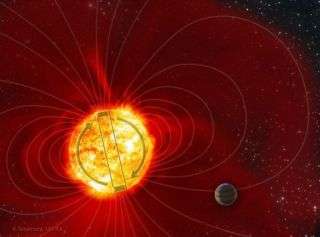
Artist's impression of 'tau Bootis' flipping its north and south magnetic poles. Credit: Art by Karen Teramura, University of Hawaii Institute for Astronomy

An international team of astrophysicists has, for the first time, discovered a star other than the Sun flipping its north and south magnetic poles.

The discovery, which involved researchers from the University of St Andrews, could help astronomers develop a better understanding of the "magnetic engine" of the Sun.

Professor Andrew Collier Cameron and Dr Moira Jardine from the University's School of Physics and Astronomy were amongst the researchers who caught the star "tau Bootis" flipping its magnetic field from north to south.

It has been known for many years that the Sun's magnetic field changes its direction every 11 years, but this is the first time that such a change has been seen in another star.

The group of astronomers, led by Jean-Francois Donati and Claire Moutou of France, observed the star in the process of flipping its poles whilst they were mapping the magnetic fields of stars. They are now closely monitoring tau Bootis to see how long it will be before the magnetic field reverses again.

As the astronomers managed to catch tau Bootis in this state of magnetic flipping during just two years of observations, they believe it is likely that this event is much more frequent on tau Bootis than it is on the Sun. The shortened cycle of this event may be due to interactions with a nearby massive planet.

Dr Jardine explained, "This is a fascinating observation for lots of reasons. It has given us the first glimpse of how other stars flip their North and South magnetic poles.

"It also suggests however that massive planets may be able to influence the magnetic cycles of their stars.

"This is a real David and Goliath situation - normally we think Sun-like stars might influence their planets, but here it seems that the planet is in the driving seat."

The astronomers aim to develop a better understanding of how magnetic engines work in stars, including our Sun and will keep their telescopes focused on tau Bootis and its magnetic turnovers in coming years.

The star is slightly hotter and 20 percent more massive than the Sun. It is quite bright and visible with the naked eye and is located 51 light-years away from earth. It currently rises about midnight and is visible for most of the night near the bright star Arcturus in the constellation Bootis in the northeast part of the sky.

Magnetic field reversals on the Sun are closely linked to the varying number of sunspots seen on the Sun's surface. The last "solar minimum", the time when number of sunspots was the lowest and the magnetic flip occurred, was in 2007. The first sunspot of the new cycle appeared just last month.

The magnetic cycle of the Sun impacts the Earth's climate and is believed to have caused the little ice age in the seventeen century. The Earth's magnetic field also flips, although much less frequently and more erratically.

This work is published in the current British journal Monthly Notices of the Royal Astronomical Society and should help scientists understand better how magnetic engines work in stars like our Sun. Details are available at: xxx.lanl.gov/abs/0802.1584

Source: University of St Andrews

Explore further: Unusual supernova is doubly unusual for being perfectly normal

add to favorites email to friend print save as pdf

Related Stories

Study explains decades of black hole observations

Jun 14, 2013

(Phys.org) —A new study by astronomers at NASA, Johns Hopkins University and Rochester Institute of Technology confirms long-held suspicions about how stellar-mass black holes produce their highest-energy ...

Young star suggests our sun was a feisty toddler

Jun 05, 2013

If you had a time machine that could take you anywhere in the past, what time would you choose? Most people would probably pick the era of the dinosaurs in hopes of spotting a T. rex. But many astronomers would ...

Kepler provides insights into unusual dwarf star

Jun 03, 2013

(Phys.org) —Astronomer John Gizis of the University of Delaware, working with data obtained by the Kepler mission, is studying a highly unusual dwarf star and its powerful flares that may hold clues to the ...

Stars don't obliterate their planets (very often)

Jun 06, 2013

(Phys.org) —Stars have an alluring pull on planets, especially those in a class called hot Jupiters, which are gas giants that form farther from their stars before migrating inward and heating up.

Stellar winds may electrify exoplanets

Jun 05, 2013

(Phys.org) —The strangest class of exoplanets found to date might be even stranger than astronomers have thought. A new model suggests that they are partially heated by electric currents linked to their host stars. Florida ...

Recommended for you

Three centaurs follow Uranus through the solar system

Jun 18, 2013

Astrophysicists from the Complutense University of Madrid have confirmed that Crantor, a large asteroid with a diameter of 70 km has an orbit similar to that of Uranus and takes the same amount of time to ...

Final curtain for Europe's deep-space telescope

Jun 17, 2013

The deep-space telescope Herschel took its final bow on Monday, climaxing a successful four-year mission to observe the birth of stars and galaxies, the European Space Agency (ESA) said.

Hubble spots a very bright contortionist

Jun 17, 2013

(Phys.org) —The contorted object captured by Hubble in this picture is IRAS 22491-1808, also known as the South America Galaxy. It is an ultra-luminous infrared galaxy (ULIRG) that emits a huge amount of ...

Study explains decades of black hole observations

Jun 14, 2013

(Phys.org) —A new study by astronomers at NASA, Johns Hopkins University and Rochester Institute of Technology confirms long-held suspicions about how stellar-mass black holes produce their highest-energy ...

User comments : 0

More news stories

Metamorphosis of moon's water ice explained

Using data gathered by NASA's Lunar Reconnaissance Orbiter (LRO) mission, scientists believe they have solved a mystery from one of the solar system's coldest regions—a permanently shadowed crater on the ...

US doctors' group labels obesity a disease

(HealthDay)—In an effort to focus greater attention on the weight-gain epidemic plaguing the United States, the American Medical Association has now classified obesity as a disease.