February 13, 2008 feature
Desert Snake Hears Mouse Footsteps with its Jaw
Just a few decades ago, some scientists doubted that snakes could hear at all. Snakes lack an outer ear and external ear openings, making it difficult to understand how the reptiles receive acoustic vibrations.
However, snakes do have an inner ear and a cochlea, and scientists have observed the animals react to auditory stimuli. But exactly how snakes hear without external ears is still unclear. In a new study, physicists Paul Friedel and J. Leo van Hemmen from the Technische Universitat Munchen in Germany and biologist Bruce Young from Washburn University in Kansas have presented a model of how the horned desert viper Cerastes cerastes hears – with its jaws.
While the jaw-hearing method is widely known, the new research uses naval engineering techniques to explain how vibrations from the jaw travel through the head and give rise to sounds in the animal’s brain. The scientists also explain one of the more intriguing parts of jaw-hearing, which is that the snake’s left and right sides of its jaw can move independently in order to localize a sound’s source, such as the location of a mouse’s footsteps.
“Up to now, no one has ever pondered the fact that snakes could use jaw-hearing in stereo,” Friedel told PhysOrg.com. “This is, however, crucial, since stereo hearing is essential for locating a sound source. We have thus explained how jaw-hearing can actually be very informative for the snake, and not simply a system signifying that ‘something is there.’”
As a mouse skitters across the desert sand, its footsteps create surface waves (specifically, Raleigh waves) with a wavelength of about 15 centimeters and amplitude of the order of 1 micrometer. These surface waves are similar to water waves, in the sense that the sand particles (modeled as a continuous medium) carry out an elliptic motion. The wave velocity of the ripples is about 45 meters per second. The frequency of the waves peaks between 200 and 1000 Hz – which falls squarely into the snake’s optimal sensitivity for frequencies of around 300 Hz.
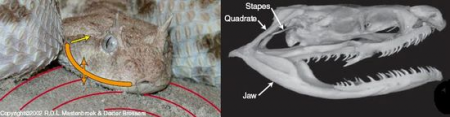
When the horned desert viper has its jaw resting on the sand, the vibrations from the mouse footsteps pass underneath both sides of the jaw. The vibrations travel through the snake’s head through two bones – the quadrate and stapes – and then stimulate the cochlea. The snake’s auditory system can sense jaw movement down to angstrom-sized motions (on the order of a single atom). The scientists determined that the lower jaw amplitude is about half that of the 1-micrometer incoming surface wave – plenty large enough for the snake ear to detect with efficiency.
From the cochlea, the auditory signals are relayed along axonal delay lines to a set of topographically organized map neurons in the brain. The researchers modeled this neuronal network, where every map neuron is tuned with microsecond accuracy to a specific “interaural time difference,” or the time difference between signals received from the left and right sides of the jaw. When a map neuron fires, it corresponds to a specific input direction, enabling the snake to localize its prey with stereo precision.
The hearing model gives strong support to snakes’ unusual way of hearing, showing that the technique is not only possible, but is also a highly efficient survival mechanism. As Friedel explains, the jaw-hearing method offers some advantages compared with the conventional hearing method using outer ears.
“This has to do with the so-called impedance matching problem,” he said. “If air-born sound arrives at a tissue surface, most of the energy will be reflected. This is because the acoustic impedance (which is a measure of how ‘easily a sound wave can be generated’) of air is much smaller than that of tissue (or the inner ear). To solve this problem, the mammalian middle ear possesses three hearing ossicles that transfer the sound from the tympanic membrane through the inner ear. The snake does not have a middle ear with three ossicles, but by using the jaw-quadrate-stapes pathway, the problem of impedance matching is avoided.”
More information: Friedel, Paul, Young, Bruce A., and van Hemmen, J. Leo. “Auditory Localization of Ground-Borne Vibrations in Snakes.” Physical Review Letters, 100, 048701 (2008).
Copyright 2008 PhysOrg.com.
All rights reserved. This material may not be published, broadcast, rewritten or redistributed in whole or part without the express written permission of PhysOrg.com.


