ESA presents Mars in 3D
Feb 05, 2008
ESA presents Mars in 3D
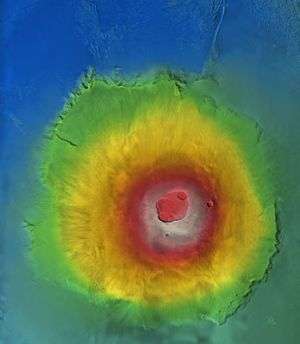
This is a mosaic of Olympus Mons, the highest volcano on Mars, which towers 26 km above the surrounding plains. The image covers an area of approximately 600 000 sq km and is colour-coded according to height based on data from the Digital Terrain Model (DTM). The High Resolution Stereo Camera (HRSC) on board ESA’s Mars Express orbiter imaged the region over 18 orbits. Credits: ESA/ DLR/ FU Berlin (G. Neukum)

Mars is about to come into 3D focus as never before, thanks to the data from the Mars Express High Resolution Stereo Camera (HRSC). A new high-resolution Digital Terrain Model data set that has just been released onto the Internet, will allow researchers to obtain new information about the Red Planet in 3D.

Digital Terrain Models (DTMs) allow scientists to ‘stand’ on planetary surfaces. Although ordinary images can give spectacular bird’s-eye views, they can only convey part of the picture. They miss out on the topography, or the vertical elevation of the surroundings. That’s where Mars Express comes in.

The HRSC was especially designed to provide this information and, after years of specialised data processing, the first comprehensive release of 3D data of a large part of the martian surface is now ready. “Understanding the topography of Mars is essential to understanding its geology,” says Prof. Gerhard Neukum, Freie Universität (FU) Berlin, Germany, Principal Investigator for the HRSC.

The DTM can instantly tell researchers the slope of hillsides or the height of cliffs, the altitude and slope of lava flows or desert plains. “This data is essential for understanding how water or lava flowed across Mars,” says Neukum.

It also helps planetary scientists to better interpret other data sets, for example the results of the Mars Advanced Radar for Subsurface and Ionosphere Sounding (MARSIS). “Once we know where the surface is, we can correctly interpret the radar echoes we get from below it,” says former ESA scientist Angelo Rossi, a member of the HRSC team.

The Mars Express DTM is the most detailed topographic data set ever released for Mars. Its release has been made possible by processing individual image swaths taken by the HRSC as Mars Express sweeps through its orbit. The individual swaths are then put together into mosaics that cover large regions. The high-resolution images used have a resolution of 10 m/pixel. The DTM elevation data derived from these images is provided in pixels of up to 50 m, with a height accuracy of 10 m.

The orbit of Mars Express determines the resolution of its pictures. When it is closest to the surface, it can take the most detailed pictures. “As the mission continues, we are gradually filling in the gaps and collecting high-resolution data whenever possible,” says Neukum.

The team plans to add more data to the DTMs to extend the surface coverage as Mars Express continues its mission until at least 2009 and HRSC continues its unique scrutiny of the planet.

Source: European Space Agency

Explore further: Engineering students develop a super 'space stethoscope'

add to favorites email to friend print save as pdf

Related Stories

Where is Mars's moon Deimos?

Sep 24, 2012

(Phys.org)—Despite more than a century of observations, the orbit of the Martian moon Deimos is still not known to a high degree of accuracy, but a new study using images taken by ESA's Mars Express orbiter ...

Researchers find new form of Mars lava flow

Apr 26, 2012

High-resolution photos of lava flows on Mars reveal coiling spiral patterns that resemble snail or nautilus shells. Such patterns have been found in a few locations on Earth, but never before on Mars. The ...

Battered Tharsis Tholus volcano on Mars

Nov 09, 2011

(PhysOrg.com) -- The latest image released from Mars Express reveals a large extinct volcano that has been battered and deformed over the aeons.

Light and dark in the Phoenix Lake

Nov 12, 2010

(PhysOrg.com) -- They say you can't judge a book by its cover but, with planets, first impressions do count. New images show where complex fault lines in Mars’ Phoenicis Lacus region have resulted in ...

Just how low can Mars go?

Oct 08, 2010

There are few places on Mars lower than this. On the left of this image, the floor of Melas Chasma sinks nine kilometres below the surrounding plains. New images from ESA’s Mars Express highlight the ...

Recommended for you

Forecast for Titan: Wild weather could be ahead

4 hours ago

(Phys.org) —Saturn's moon Titan might be in for some wild weather as it heads into its spring and summer, if two new models are correct. Scientists think that as the seasons change in Titan's northern hemisphere, ...

SDO observes mid-level solar flare

4 hours ago

UPDATE 16:30 p.m. EDT: The M7-class flare was also associated with a coronal mass ejection or CME, another solar phenomenon that can send billions of tons of particles into space. While this CME was not Ea ...

NASA's IRIS mission readies for a new challenge

13 hours ago

(Phys.org) —The time draws near. NASA is getting ready to launch a new mission, a mission to observe a largely unexplored region of the solar atmosphere that powers its dynamic million-degree outer atmosphere and drives ...

User comments : 0

More news stories

Forecast for Titan: Wild weather could be ahead

(Phys.org) —Saturn's moon Titan might be in for some wild weather as it heads into its spring and summer, if two new models are correct. Scientists think that as the seasons change in Titan's northern hemisphere, ...

SDO observes mid-level solar flare

UPDATE 16:30 p.m. EDT: The M7-class flare was also associated with a coronal mass ejection or CME, another solar phenomenon that can send billions of tons of particles into space. While this CME was not Ea ...