The Gough Map: the earliest road map of Britain?
Feb 04, 2008
The Gough Map: the earliest road map of Britain?
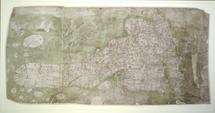
The map is the first to depict Britain with a recognizable coastline.

One of the most important and earliest maps ever made in Britain is the subject of a new book just published by the Bodleian Library.

The Gough Map: The earliest road map of Britain explores the hidden secrets and baffling detail of one of the greatest medieval cartographic artefacts. Dating from around 1360, the Gough Map is the earliest surviving map of Great Britain to show routes across Britain and to depict the island with a recognizable coastline. Although the identity of the map-maker is unknown, the map can be accurately dated by historical reference and the handwriting on the map.

The anonymous artefact – which takes its name from Richard Gough, an 18th-century antiquary and authority on British topography – has been under continuous analytical scrutiny, for centuries.

Recent digitization of the map is helping to provide answers to some of these questions and is making the map more legible than at any other time since its arrival in the Bodleian in 1809. This process has also made it possible to project a modern map of Britain over the Gough Map (georectification), demonstrating the remarkable accuracy of much of this 650-year-old route map.

Here in stunning detail are the principal medieval settlements of Great Britain, from Bristol, through Oxford, and over to Norwich; the Severn, Thames, and Humber rivers, and even the loop of the Wear at Durham; Scotland, assuming an unfamiliar shape; the routes between towns, marked in red with distances included in Roman numerals; and even a single tree, identifying the New Forest.

This beautifully illustrated book contains not only a fold-out print of the map but also many close-up images of each area, providing an unparalleled opportunity to view this spectacular and engaging survival from medieval map-making.

Nick Millea, Map Librarian, Bodleian Library, said: ‘The Gough Map is one of the Bodleian Library’s greatest treasures. There is no record of any similar contemporary map at such scale or indeed accuracy: such is its quality and detail that it remained the blueprint for cartographers for 200 years.’

Source: Oxford University

Explore further: Fossil brain teaser: New study reveals patterns of dinosaur brain development

add to favorites email to friend print save as pdf

Related Stories

Unravelling the mysteries of medieval Gough Map

Aug 15, 2011

The secrets embedded in one of the earliest maps to show Britain in its geographically recognised form have been uncovered, as researchers launch the newly digitised Gough Map.

Earliest medieval map of Britain put online

Aug 03, 2011

A fifteen-month research project of the earliest surviving geographically recognizable map of Great Britain, known as the Gough Map, provides some revealing insights into one of the most enigmatic cartographic ...

Recommended for you

Tiny ancient bandicoot shines light on future

6 hours ago

(Phys.org) —A 20 million-year-old fossil skull identified as a 'pocket-sized' ancestor of the bandicoot will give insights into the future of Australia's modern endangered animals.

The eloquence of the otoliths

May 16, 2013

Fish fossils that are about 23 million years old give unprecedented insight into the evolutionary history of the gobioid order, one of the most species-rich groups among the modern bony fishes.

Light cast on lifestyle and diet of first New Zealanders

May 16, 2013

(Phys.org) —A University of Otago-led multidisciplinary team of scientists have shed new light on the diet, lifestyles and movements of the first New Zealanders by analysing isotopes from their bones and teeth.

User comments : 0

More news stories

Tiny ancient bandicoot shines light on future

(Phys.org) —A 20 million-year-old fossil skull identified as a 'pocket-sized' ancestor of the bandicoot will give insights into the future of Australia's modern endangered animals.

Relaxed tourists share more

Tourists set on relaxing and socialising when they reach their holiday destination tend to do little advance research on the internet before making their trip, but are more likely to share travel information and photos on ...

Daylight Saving Time spurs drop in crime rate

(Phys.org) —Researchers are no longer in the dark about when criminals are most likely to attack. William & Mary economist Nicholas Sanders teamed up with the University of Virginia's Jennifer Doleac to study the connection ...

Tiny, implantable coil promises hope for emphysema patients

A small, easily implantable device called the Lung Volume Reduction Coil (LVRC) may play a key role in the treatment of two types of emphysema, according to a study conducted in Europe. Results of the study indicate the beneficial ...