21st century water management: Calculating with the unknown
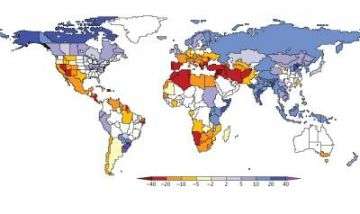
Climate change is making a central assumption of water management obsolete: Water-resource risk assessment and planning are currently based on the notion that factors such as precipitation and streamflow fluctuate within an unchanging envelope of variability. But anthropogenic change of Earth’s climate is altering the means and extremes of these factors so that this paradigm of stationarity no longer applies, researchers report in the latest issue of Science.
Water professionals around the world have always had to balance water supply and demand and to minimize risks to life and property without knowing what future events nature has in store. Historically, looking back at past observations has been a good way to estimate future conditions. “But climate change magnifies the possibility that the future will bring droughts or floods never seen in old measurements,” says Christopher Milly.
“When planning grand investments in water infrastructure area, one has to consider the uncertain and changing climate,” says Zbigniew Kundzewicz, leader of the hydrology group at the Potsdam Institute for Climate Impact Research and co-author of the Science article. Annual global investment in water infrastructure, e.g. canalization, dams or power stations, exceeds 500 billion US dollars. When planning new infrastructure and renewing decaying one non-stationarity has to be taken into account. “Large projected changes in runoff push hydroclimate beyond the range of historical behavior,” says Kundzewicz.
As the authors point out in their article, warming augments atmospheric humidity and water transport. This increases precipitation, and possibly flood risk, where prevailing atmospheric water-vapor fluxes converge. Glacial meltwater temporarily enhances water availability, but glacier and snow-pack losses diminish natural storage of freshwater. In coastal regions the supplies are endangered by rising sea levels. The risk of contamination with seawater is heightened, the authors state.
From projections of future water availability a picture emerges of regional gainers and losers. The paper by Milly et al. contains a global map illustrating the projected changes at the level of countries, and partly states or provinces. Climate models show where the runoff changes are projected to be largest. The global pattern of already visible annual streamflow trends is unlikely to have arisen by chance and is consistent with modeled response to climate forcing. Water availability will probably increase substantially in high latitudes of the northern Hemisphere and some tropical regions and decrease substantially in the Mediterranean basin, southern Africa and south-western North America. “These drying regions are likely to experience increasing drought frequency in the future,” says Milly.
“Stationarity cannot be revived,” says Kundzewicz. Even with aggressive mitigation of climate change, continued warming is very likely, given the residence time of atmospheric carbon dioxide and the thermal inertia of the earth system. However, the rational water resources planning framework can be adapted to the changing climate. The information base changes rapidly with climate science advances.
A rapid exchange of climate-change information between the scientific realm and water managers will be critical, the authors state. New, higher-resolution models could then represent surface- and ground-water processes more explicitly. These models need to include water infrastructure, and water users, including the agricultural and energy sectors. Modeling should be used to synthesize observations, but it can never replace them, the authors write and suggest to update the analytical strategies used for planning under conditions of non-stationarity. “The assumption that the past is the key to the future has lost much of its value for water management,” says Kundzewicz.
The headline of the article by Christopher Milly, US Geological Survey (USGS), and others reads “Stationarity is dead: Whither Water Management?”.
Source: Potsdam Institute for Climate Impact Research


