NASA Scientists Get First Images of Earth Flyby Asteroid
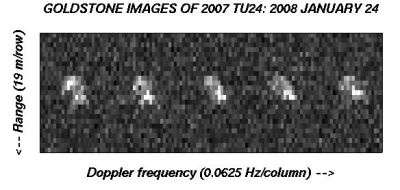
Scientists at NASA's Jet Propulsion Laboratory in Pasadena, Calif., have obtained the first images of asteroid 2007 TU24 using high-resolution radar data. The data indicate the asteroid is somewhat asymmetrical in shape, with a diameter roughly 250 meters (800 feet) in size. Asteroid 2007 TU24 will pass within 1.4 lunar distances, or 538,000 kilometers (334,000 miles), of Earth on Jan. 29 at 12:33 a.m. Pacific time (3:33 a.m. Eastern time).
"With these first radar observations finished, we can guarantee that next week's 1.4-lunar-distance approach is the closest until at least the end of the next century," said Steve Ostro, JPL astronomer and principal investigator for the project. "It is also the asteroid's closest Earth approach for more than 2,000 years."
Scientists at NASA's Near-Earth Object Program Office at JPL have determined that there is no possibility of an impact with Earth in the foreseeable future.
Asteroid 2007 TU24 was discovered by the NASA-sponsored Catalina Sky Survey on Oct. 11, 2007. The first radar detection of the asteroid was acquired on Jan. 23 using the Goldstone 70-meter (230-foot) antenna. The Goldstone antenna is part of NASA's Deep Space Network Goldstone station in Southern California's Mojave Desert. Goldstone's 70-meter diameter (230-foot) antenna is capable of tracking a spacecraft traveling more than 16 billion kilometers (10 billion miles) from Earth. The surface of the 70-meter reflector must remain accurate within a fraction of the signal wavelength, meaning that the precision across the 3,850-square-meter (41,400-square-foot) surface is maintained within one centimeter (0.4 inch).
Ostro and his team plan further radar observations of asteroid 2007 TU24 using the National Science Foundation's Arecibo Observatory in Puerto Rico on Jan. 27-28 and Feb. 1-4.
The asteroid will reach an approximate apparent magnitude 10.3 on Jan. 29-30 before quickly becoming fainter as it moves farther from Earth. On that night, the asteroid will be observable in dark and clear skies through amateur telescopes with apertures of at least 7.6 centimeters (three inches). An object with a magnitude of 10.3 is about 50 times fainter than an object just visible to the naked eye in a clear, dark sky.
Scientists working with Ostro on the project include Lance Benner and Jon Giorgini of JPL, Mike Nolan of the Arecibo Observatory, and Greg Black of the University of Virginia.
NASA detects and tracks asteroids and comets passing close to Earth. The Near Earth Object Observation Program, commonly called "Spaceguard," discovers, characterizes and computes trajectories for these objects to determine if any could be potentially hazardous to our planet. The Arecibo Observatory is part of the National Astronomy and Ionosphere Center, a national research center operated by Cornell University, Ithaca, N.Y., for the National Science Foundation.
Source: NASA


