Chandra Lifts the Veil on Milky Way 'Hotspot'
Jan 23, 2008
Westerlund 2: A Stellar Site
Image credit: NASA/CXC/Univ. de Liege/Y. Nael et al

NASA's Chandra X-ray Observatory is helping to demystify Westerlund 2, a young star cluster with an estimated age of about one- or two-million years. Heavily obscured by dust and gas, Westerlund 2 has been something of a Milky Way mystery. But now infrared and X-ray observations are peering through the obstacles. This cluster contains some of the hottest, brightest and most massive stars yet discovered.

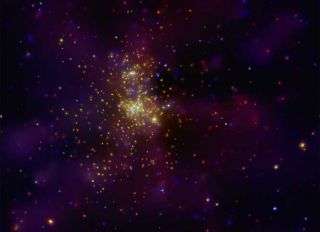
This Chandra X-ray Observatory image shows Westerlund 2, a young star cluster with an estimated age of about one or two million years. Until recently little was known about this cluster because it is heavily obscured by dust and gas.

However, using infrared and X-ray observations to overcome this obscuration, Westerlund 2 has become regarded as one of the most interesting star clusters in the Milky Way galaxy. It contains some of the hottest, brightest and most massive stars known.

This Chandra image of Westerlund 2 shows low energy X-rays in red, intermediate energy X-rays in green and high energy X-rays in blue. The image shows a very high density of massive stars that are bright in X-rays, plus diffuse X-ray emission.

An incredibly massive double star system called WR20a is visible as the bright yellow point just below and to the right of the cluster's center. This system contains stars with masses of 82 and 83 times that of the Sun. The dense streams of matter steadily ejected by these two massive stars, called stellar winds, collide with each other and produce copious amounts of X-ray emission.

This collision is seen at different angles as the stars orbit around each other every 3.7 days. Several other bright X-ray sources may also show evidence for collisions between winds in massive binary systems.

Source: NASA

Explore further: Final curtain for Europe's deep-space telescope

add to favorites email to friend print save as pdf

Related Stories

Tablets thrust Thai classrooms into digital era

4 minutes ago

In a rural classroom in the Thai highlands, hill tribe children energetically slide their fingertips over tablet computer screens practicing everything from English to mathematics and music.

Lebanese start-ups seek tech boom

14 minutes ago

Lebanon has long suffered with some of the slowest Internet speeds in the world, but a new crop of online entrepreneurs believes their country is primed for a tech start-up boom.

Egypt, Ethiopia in further talks over Nile dam

24 minutes ago

Ethiopia and Egypt have agreed to hold further talks on the impact of an Ethiopian dam to quell tensions between the two countries, the foreign ministers of both nations said Tuesday.

Mysterious Steve Jobs emails hang over Apple trial

54 minutes ago

The late Steve Jobs took center stage Monday in the latest twist in the Apple antitrust trial on ebooks. A federal court attempted to plumb the meaning of a series of unsent emails Jobs addressed to Eddy Cue, an Apple senior ...

Recommended for you

Three centaurs follow Uranus through the solar system

12 hours ago

Astrophysicists from the Complutense University of Madrid have confirmed that Crantor, a large asteroid with a diameter of 70 km has an orbit similar to that of Uranus and takes the same amount of time to ...

Final curtain for Europe's deep-space telescope

Jun 17, 2013

The deep-space telescope Herschel took its final bow on Monday, climaxing a successful four-year mission to observe the birth of stars and galaxies, the European Space Agency (ESA) said.

Hubble spots a very bright contortionist

Jun 17, 2013

(Phys.org) —The contorted object captured by Hubble in this picture is IRAS 22491-1808, also known as the South America Galaxy. It is an ultra-luminous infrared galaxy (ULIRG) that emits a huge amount of ...

Study explains decades of black hole observations

Jun 14, 2013

(Phys.org) —A new study by astronomers at NASA, Johns Hopkins University and Rochester Institute of Technology confirms long-held suspicions about how stellar-mass black holes produce their highest-energy ...

User comments : 1

Adjust slider to filter visible comments by rank

Display comments: newest first

RAL
not rated yet Jan 24, 2008
Any chance that Physorg could include a link to a larger picture on some of these articles? Just a suggestion.

More news stories

3D printing tiny batteries

(Phys.org) —3D printing can now be used to print lithium-ion microbatteries the size of a grain of sand. The printed microbatteries could supply electricity to tiny devices in fields from medicine to communications, ...