MESSENGER Reveals Mercury in New Detail
Jan 16, 2008
MESSENGER Reveals Mercury in New Detail
Credit: NASA/Johns Hopkins University Applied Physics Laboratory/Carnegie Institution of Washington

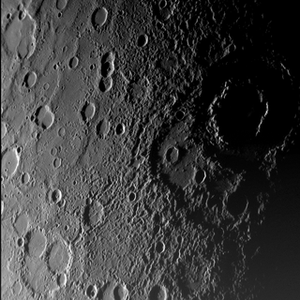
As MESSENGER approached Mercury on January 14, 2008, the spacecraft’s Narrow-Angle Camera on the Mercury Dual Imaging System (MDIS) instrument captured this view of the planet’s rugged, cratered landscape illuminated obliquely by the Sun.

The large, shadow-filled, double ringed crater to the upper right was glimpsed by Mariner 10 more than three decades ago and named Vivaldi, after the Italian composer. Its outer ring has a diameter of about 200 kilometers (about 125 miles).

MESSENGER’s modern camera has revealed detail that was not well seen by Mariner 10, including the broad ancient depression overlapped by the lower-left part of the Vivaldi crater. The MESSENGER science team is in the process of evaluating later images snapped from even closer range showing features on the side of Mercury never seen by Mariner 10.

It is already clear that MESSENGER’s superior camera will tell us much that could not be resolved even on the side of Mercury viewed by Mariner’s vidicon camera in the mid-1970s.

This MESSENGER image was taken from a distance of about18,000 kilometers (11,000 miles), about 56 minutes before the spacecraft's closest encounter with Mercury. It shows a region roughly 500 kilometers (300 miles) across, and craters as small as 1 kilometer (0.6 mile) can be seen in this image.

Source: JHU/APL

Explore further: Collisions of coronal mass ejections can be super-elastic

add to favorites email to friend print save as pdf

Related Stories

MESSENGER Marks 8th Anniversary of Launch

Aug 03, 2012

(Phys.org) -- The MESSENGER spacecraft launched eight years ago today — on August 3, 2004 — embarking on a six-and-a-half year journey to become the first spacecraft to orbit Mercury. The spacecraft's ...

Warhol crater gets its 15 minutes of fame

May 15, 2012

As pop art icon Andy Warhol said, “In the future everyone will be famous for fifteen minutes,”  and so here’s an image of the crater on Mercury that now bears his name, set up in the style ...

MESSENGER reveals Mercury’s colors

Apr 23, 2012

The subtle yet surprisingly varied colors of Mercury are revealed in the latest images from NASA’s MESSENGER spacecraft, now in its extended mission and second year in orbit.

MESSENGER gets it Donne

Apr 09, 2012

Named after the 17th-century metaphysical poet, Mercury’s Donne crater was captured in this image by NASA’s MESSENGER spacecraft. The 53-mile (83-km) -wide crater features a large, rounded central ...

Bright peaks, dark shadows

Feb 20, 2012

The 68-mile (109-km) -wide Amaral crater on Mercury reveals its brightly-tipped central peaks in this image, acquired by NASA’s MESSENGER spacecraft on Feb. 4, 2012. Long shadows are cast by the crater’s ...

Incredible ‘sideways’ look at Mercury’s limb

Nov 29, 2011

Wow -- just wow! Here’s a unique, jaw-dropping, and beautiful look at Mercury from the MESSENGER spacecraft, in a mosaic created from nine images taken by the Narrow Angle Camera (NAC) of the Mercury ...

Recommended for you

NASA head views progress on asteroid lasso mission

10 hours ago

Surrounded by engineers, NASA chief Charles Bolden inspected a prototype spacecraft engine that could power an audacious mission to lasso an asteroid and tow it closer to Earth for astronauts to explore.

Ecuador satellite collides with Russian space junk

10 hours ago

A small Ecuadoran satellite collided in orbit with the remains of a Russian rocket, but it is too soon to know how much damage it might have sustained, Quito's space agency said Thursday.

Forecast for Titan: Wild weather could be ahead

May 22, 2013

(Phys.org) —Saturn's moon Titan might be in for some wild weather as it heads into its spring and summer, if two new models are correct. Scientists think that as the seasons change in Titan's northern hemisphere, ...

SDO observes mid-level solar flare

May 22, 2013

UPDATE 16:30 p.m. EDT: The M7-class flare was also associated with a coronal mass ejection or CME, another solar phenomenon that can send billions of tons of particles into space. While this CME was not Ea ...

User comments : 0

More news stories

A hidden population of exotic neutron stars

(Phys.org) —Magnetars – the dense remains of dead stars that erupt sporadically with bursts of high-energy radiation - are some of the most extreme objects known in the Universe. A major campaign using ...

Hubble reveals the ring nebula's true shape

(Phys.org) —The Ring Nebula's distinctive shape makes it a popular illustration for astronomy books. But new observations by NASA's Hubble Space Telescope of the glowing gas shroud around an old, dying, ...

NASA head views progress on asteroid lasso mission

Surrounded by engineers, NASA chief Charles Bolden inspected a prototype spacecraft engine that could power an audacious mission to lasso an asteroid and tow it closer to Earth for astronauts to explore.

Controlling mood through the motions of mitochondria

(Medical Xpress)—Regulating the distribution of power in neurons is done by a system that makes the national electric grid look simple by comparison. Each neuron has several thousand mitochondria confined ...

A quantum simulator for magnetic materials

Physicists understand perfectly well why a fridge magnet sticks to certain metallic surfaces. But there are more exotic forms of magnetism whose properties remain unclear, despite decades of intense research. ...