NASA Satellites Capture Start of New Solar Cycle
NASA scientists say a new solar cycle is beginning, and this could have important repercussions for space-based technology ranging from GPS navigation to weather satellites.
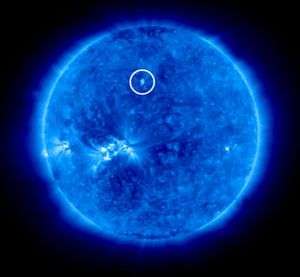
On January 4, a reversed-polarity sunspot appeared, signaling the start of Solar Cycle 24. A sunspot is an area of magnetic activity on the surface of the sun that appears as a dark spot on its surface. Solar activity waxes and wanes in 11-year cycles and the previous solar cycle, Solar Cycle 23, peaked in 2000-2002 with many furious solar storms.
Lately, the sun has been experiencing very few flares, sunspots, or activity of any kind -- a period of quiet called solar minimum. Now, the sun’s seasons are changing again. David Hathaway, solar physicist at NASA’s Marshall Space Flight Center in Huntsville, Ala., says, “New solar cycles always begin with a high-latitude, reversed polarity sunspot."
"Reversed polarity" means a sunspot with opposite magnetic polarity compared to sunspots from the previous solar cycle. "High-latitude" refers to the sun's grid of latitude and longitude. Old cycle spots congregate near the sun's equator. New cycle spots appear higher, around 25 or 30 degrees latitude.
The sunspot that appeared January 4 fits both these criteria. It is high latitude (30 degrees N) and magnetically reversed. The National Oceanic and Atmospheric Administration (NOAA) has named the spot AR10,981, or “sunspot 981” for short. Sunspot 981 was small -- only about as wide as Earth, which counts as small on the grand scale of the Sun -- and it has already faded away. But its three-day appearance January 4 through January 6 was enough to convince most solar physicists that Solar Cycle 24 is underway. The onset of a new solar cycle is significant because of our increasingly space-based technological society.
“Solar storms can disable satellites that we depend on for weather forecasts and GPS navigation,” says Hathaway. Radio bursts from solar flares can directly interfere with cell phone reception while coronal mass ejections (CMEs) hitting Earth can cause actual power outages.
Air travel can be affected, too. When airplanes fly over the poles during solar storms, they can experience radio blackouts, navigation errors and computer reboots all caused by space radiation. Avoiding the poles during solar storms solves the problem, but it costs extra time, money and fuel to take the longer route.
NASA is gearing up to study the active sun during Cycle 24 with the launch of a new spacecraft, the Solar Dynamics Observatory. “SDO is a very special observatory,” says project scientist Dean Pesnell at NASA's Goddard Space Flight Center in Greenbelt, Md. “Using a technique called helioseismic imaging, the spacecraft will be able to look inside the sun where solar activity begins. SDO will join SOHO, the Solar Terrestrial Relations Observatory (STEREO), Hinode and other missions already in orbit to improve our understanding of solar storms and lay the groundwork for better space weather forecasts.”
"The beginning of the new solar cycle occurs just as the STEREO Mission is completing its first year of operation," says Mike Kaiser, STEREO Project Scientist at NASA Goddard. "The twin STEREO spacecraft are now 45 degrees apart and are in good position to triangulate on solar activity from the new cycle to provide better understanding of solar storms that can disrupt our electronic lives. Ultimately, the research done by STEREO and other solar missions will lead to more accurate predictions of when solar storms will impact Earth."
“Intense solar activity won't begin immediately,” notes Hathaway. “Solar cycles usually take a few years to build from solar minimum (where we are now) to Solar max, expected in 2011 or 2012.”
Source: by Jennifer Morcone and Rob Gutro, NASA's Marshall and Goddard space flight centers


