NIST reference materials are 'gold standard' for bio-nanotech research
Jan 09, 2008
NIST reference materials are 'gold standard' for bio-nanotech research
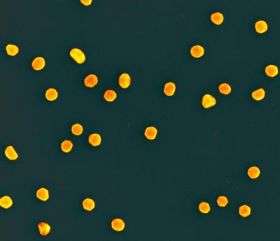
False color scanning electron micrograph (250,000 times magnification) showing the gold nanoparticles created by NIST and the National Cancer Institute's Nanotechnology Characterization Laboratory for use as reference standards in biomedical research laboratories. Credit: Andras Vladar, NIST

The National Institute of Standards and Technology has issued its first reference standards for nanoscale particles targeted for the biomedical research community—literally “gold standards” for labs studying the biological effects of nanoparticles. The three new materials, gold spheres nominally 10, 30 and 60 nanometers in diameter, were developed in cooperation with the National Cancer Institute’s Nanotechnology Characterization Laboratory (NCL).

Nanosized particles are the subject of a great deal of biological research, in part because of concerns that in addition to having unique physical properties due to their size, they also may have unique biological properties. On the negative side, nanoparticles may have special toxicity issues.

On the positive side, they also are being studied as vehicles for targeted drug delivery that have the potential to revolutionize cancer treatments. Research in the field has suffered from a lack of reliable nanoscale measurement standards, both to ensure consistency of data from one lab to the next and to verify the performance of measurement instruments and analytic techniques.

The new NIST reference materials are citrate-stabilized nanosized gold particles in a colloidal suspension in water. They have been extensively analyzed by NIST scientists to assess particle size and size distribution by multiple techniques for dry-deposited, aerosol and liquid-borne forms of the material. Dimensions were measured using six independent methods—including atomic force microscopy (AFM), transmission electron microscopy (TEM), scanning electron microscopy (SEM), differential mobility analysis (DMA), dynamic light scattering (DLS), and small-angle X-ray scattering (SAXS). At the nanoscale in particular, different measurement techniques can and will produce different types of values for the same particles.

In addition to average size and size distributions, the new materials have been chemically analyzed for the concentrations of gold, chloride ion, sodium and citrate, as well as pH, electrical conductivity, and zeta potential (a measure of the stability of the colloidal solution). They have been sterilized with gamma radiation and tested for sterility and endotoxins. Details of the measurement procedures and data are included in a report of investigation accompanying each sample.

Source: National Institute of Standards and Technology

Explore further: Hybrid material as gold-leaf substitute

add to favorites email to friend print save as pdf

Related Stories

Single cells: Same same but different

Jun 12, 2013

(Phys.org) —If half of a cell population were coloured white and the other half were coloured black, scientists should think all cells are grey. Conventional methods average over thousands of cells, overlooking ...

Luggage screening standards prove their value

Jun 11, 2013

Every month, between 50 and 70 million passengers travel through U.S. airports, toting more than 30 million pieces of luggage destined for aircraft cargo holds. Since 2004, federal legislation requires that ...

Recommended for you

Hybrid material as gold-leaf substitute

11 hours ago

(Phys.org) —A team of researchers headed by Professor Raffaele Mezzenga has created a hybrid material out of gold and milk proteins that looks like a wafer-thin gold leaf. Thanks to its properties, it could ...

Antioxidant with a long shelf life

Jun 17, 2013

(Phys.org) —Scientists from ETH Zurich have developed a nanomaterial that protects other molecules from oxidation. Unlike many such active substances in the past, the ETH-Zurich researchers' antioxidant ...

Fast pollutant degradation by nanosheets

Jun 17, 2013

(Phys.org) —Waste from textile and paint industries often contains organic dyes such as methylene blue as pollutants. Photocatalysis is an efficient means of reducing such pollution, and molybdenum trioxide ...

Unzipped nanotubes unlock potential for batteries

Jun 13, 2013

(Phys.org) —Researchers at Rice University have come up with a new way to boost the efficiency of the ubiquitous lithium ion (LI) battery by employing ribbons of graphene that start as carbon nanotubes.

Nanoparticle opens the door to clean-energy alternatives

Jun 13, 2013

(Phys.org) —Cheaper clean-energy technologies could be made possible thanks to a new discovery. Research team members led by Raymond Schaak, a professor of chemistry at Penn State University, have found ...

User comments : 0

More news stories

3D printing tiny batteries

(Phys.org) —3D printing can now be used to print lithium-ion microbatteries the size of a grain of sand. The printed microbatteries could supply electricity to tiny devices in fields from medicine to communications, ...

Future looks bright for carbon nanotube solar cells

(Phys.org) —In an approach that could challenge silicon as the predominant photovoltaic cell material, University of Wisconsin-Madison materials engineers have developed an inexpensive solar cell that exploits ...

Hybrid material as gold-leaf substitute

(Phys.org) —A team of researchers headed by Professor Raffaele Mezzenga has created a hybrid material out of gold and milk proteins that looks like a wafer-thin gold leaf. Thanks to its properties, it could ...

World's most powerful microscope ready for research

(Phys.org) —The world's most powerful microscope, which resides in a specially constructed room at the University of Victoria, has now been fully assembled and tested, and has a lineup of scientists and businesses eager ...

Study suggests new approach to fight lung cancer

Recent research has shown that cancer cells have a much different – and more complex – metabolism than normal cells. Now, scientists at The University of Texas at Dallas have found that exploiting these differences might ...