Is a New Solar Cycle Beginning?
Dec 17, 2007
Is a New Solar Cycle Beginning?
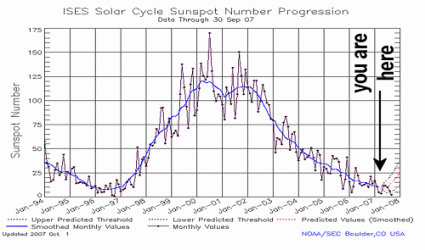
Solar Cycle 23 is coming to an end. What's next? Image credit: NOAA/Space Weather Prediction Center.

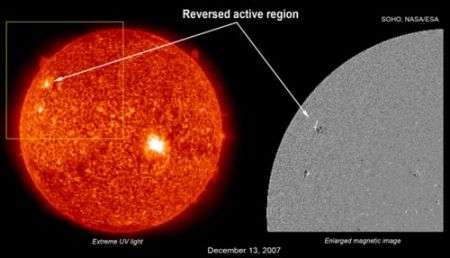
The solar physics community is abuzz this week. No, there haven't been any great eruptions or solar storms. The source of the excitement is a modest knot of magnetism that popped over the sun's eastern limb on Dec. 11th, pictured below in a pair of images from the orbiting Solar and Heliospheric Observatory (SOHO).

It may not look like much, but "this patch of magnetism could be a sign of the next solar cycle," says solar physicist David Hathaway of the Marshall Space Flight Center.

For more than a year, the sun has been experiencing a lull in activity, marking the end of Solar Cycle 23, which peaked with many furious storms in 2000--2003. "Solar minimum is upon us," he says.

The big question now is, when will the next solar cycle begin?

It could be starting now.
Is a New Solar Cycle Beginning?
From SOHO, a UV-wavelength image of the sun and a map showing positive (white) and negative (black) magnetic polarities. The new high-latitude active region is magnetically reversed, marking it as a harbinger of a new solar cycle.

"New solar cycles always begin with a high-latitude, reversed polarity sunspot," explains Hathaway. "Reversed polarity " means a sunspot with opposite magnetic polarity compared to sunspots from the previous solar cycle. "High-latitude" refers to the sun's grid of latitude and longitude. Old cycle spots congregate near the sun's equator. New cycle spots appear higher, around 25 or 30 degrees latitude.

The region that appeared on Dec. 11th fits both these criteria. It is high latitude (24 degrees N) and magnetically reversed. Just one problem: There is no sunspot. So far the region is just a bright knot of magnetic fields. If, however, these fields coalesce into a dark sunspot, scientists are ready to announce that Solar Cycle 24 has officially begun.

Many forecasters believe Solar Cycle 24 will be big and intense. Peaking in 2011 or 2012, the cycle to come could have significant impacts on telecommunications, air traffic, power grids and GPS systems. (And don't forget the Northern Lights!) In this age of satellites and cell phones, the next solar cycle could make itself felt as never before.

The furious storms won't start right away, however. Solar cycles usually take a few years to build to a frenzy and Cycle 24 will be no exception. "We still have some quiet times ahead," says Hathaway.

Meanwhile, all eyes are on a promising little active region. Will it become the first sunspot of a new solar cycle?

Source: by Dr. Tony Phillips, Science@NASA

Explore further: Forecast for Titan: Wild weather could be ahead

add to favorites email to friend print save as pdf

Related Stories

Quiet Interlude in Solar Max

Mar 08, 2013

(Phys.org) —Something unexpected is happening on the Sun. 2013 was supposed to be the year of "solar maximum," the peak of the 11-year sunspot cycle. Yet 2013 has arrived and solar activity is relatively ...

Solar cycle update: Twin peaks?

Mar 04, 2013

Something unexpected is happening on the sun. 2013 is supposed to be the year of Solar Max, the peak of the 11-year sunspot cycle. Yet 2013 has arrived and solar activity is relatively low. Sunspot numbers ...

SORCE satellite: A Decade in the Sun

Apr 01, 2013

NASA's Solar Radiation and Climate Experiment (SORCE) satellite has been providing data on the sun's irradiance for 10 years. SORCE measures electromagnetic radiation produced by the sun and the power per ...

Recommended for you

Forecast for Titan: Wild weather could be ahead

29 minutes ago

(Phys.org) —Saturn's moon Titan might be in for some wild weather as it heads into its spring and summer, if two new models are correct. Scientists think that as the seasons change in Titan's northern hemisphere, ...

SDO observes mid-level solar flare

50 minutes ago

UPDATE 16:30 p.m. EDT: The M7-class flare was also associated with a coronal mass ejection or CME, another solar phenomenon that can send billions of tons of particles into space. While this CME was not Ea ...

NASA's IRIS mission readies for a new challenge

10 hours ago

(Phys.org) —The time draws near. NASA is getting ready to launch a new mission, a mission to observe a largely unexplored region of the solar atmosphere that powers its dynamic million-degree outer atmosphere and drives ...

Building a better team—on Mars

May 21, 2013

Sometime in the next quarter-century, NASA plans to send the first humans to Mars, a mission that will push the boundaries of teamwork for a handful of astronauts who will spend as long as three years together ...

User comments : 1

Adjust slider to filter visible comments by rank

Display comments: newest first

quantum_flux
2.7 / 5 (3) Dec 17, 2007
So, now would be a good time for NASA to launch manned space missions to the moon or unmanned space missions in general! These cycles last 11 years, so NASA should probably do something spectacular while we're at minimum time, right!?

More news stories

Forecast for Titan: Wild weather could be ahead

(Phys.org) —Saturn's moon Titan might be in for some wild weather as it heads into its spring and summer, if two new models are correct. Scientists think that as the seasons change in Titan's northern hemisphere, ...

SDO observes mid-level solar flare

UPDATE 16:30 p.m. EDT: The M7-class flare was also associated with a coronal mass ejection or CME, another solar phenomenon that can send billions of tons of particles into space. While this CME was not Ea ...

NASA's Landsat satellite looks for a cloud-free view

For decades, Landsat satellites have documented the desiccation of the Aral Sea in Central Asia. Once one of the largest seas in the world, it shrunk to a tenth of its original volume after Russia diverted ...