Coral Reefs Unlikely to Survive in Acid Oceans
Dec 13, 2007
Coral Reefs Unlikely to Survive in Acid Oceans
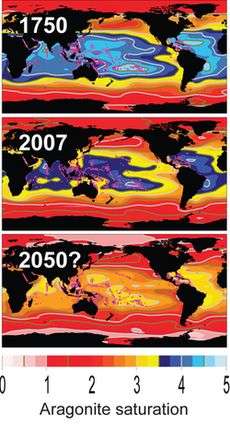
Coral reefs (magenta dots) grow in optimal conditions with aragonite saturation greater than 3.5 (blue colors). Such water is rapidly disappearing and will be gone in several decades if current carbon dioxide emission trends continue. Atmospheric CO2 levels are 380 ppm and 550 ppm for years 2007 and 2050, respectively. Credit: Carnegie Institution of Washington

Carbon emissions from human activities are not just heating up the globe, they are changing the ocean’s chemistry. This could soon be fatal to coral reefs, which are havens for marine biodiversity and underpin the economies of many coastal communities.

Scientists from the Carnegie Institution’s Department of Global Ecology have calculated that if current carbon dioxide emission trends continue, by mid-century 98% of present-day reef habitats will be bathed in water too acidic for reef growth. Among the first victims will be Australia’s Great Barrier Reef, the world’s largest organic structure.

Chemical oceanographers Ken Caldeira and Long Cao are presenting their results in a multi-author paper in the December 14 issue of Science and at the annual meeting of American Geophysical Union in San Francisco on the same date. The work is based on computer simulations of ocean chemistry under levels of atmospheric CO2 ranging from 280 parts per million (pre-industrial levels) to 5000 ppm. Present levels are 380 ppm and rapidly rising due to accelerating emissions from human activities, primarily the burning of fossil fuels.

“About a third of the carbon dioxide put into the atmosphere is absorbed by the oceans,” says Caldeira, “which helps slow greenhouse warming, but is a major pollutant of the oceans.” The absorbed CO2 produces carbonic acid, the same acid that gives soft drinks their fizz, making certain minerals called carbonate minerals dissolve more readily in seawater. This is especially true for aragonite, the mineral used by corals and many other marine organisms to grow their skeletons.

“Before the industrial revolution, over 98% of warm water coral reefs were bathed with open ocean waters 3.5 times supersaturated with aragonite, meaning that corals could easily extract it to build reefs,” says Cao. “But if atmospheric CO2 stabilizes at 550 ppm -- and even that would take concerted international effort to achieve -- no existing coral reef will remain in such an environment.” The chemical changes will impact some regions sooner than others. At greatest risk are the Great Barrier Reef and the Caribbean Sea.

Carbon dioxide’s chemical effects on the ocean are largely independent of its effects on climate, so measures to mitigate warming short of reducing emissions will be of little help in slowing acidification, the researchers say. In fact, impending chemical changes may require emissions cuts even more drastic than those for climate alone.

“These changes come at a time when reefs are already stressed by climate change, overfishing, and other types of pollution,” says Caldeira, “so unless we take action soon there is a very real possibility that coral reefs — and everything that depends on them —will not survive this century.”

Source: Carnegie Institution of Washington

Explore further: Bold action, big money needed to curb Asia floods

add to favorites email to friend print save as pdf

Related Stories

Developing a clearer understanding of ocean ecosystems

May 08, 2013

The EU-funded HERMIONE project ('Hotspot Ecosystem Research and Man's Impact on European Seas') has contributed much needed data on the complexity of deep-sea ecosystems. This in turn has created a community ...

Encroaching sea already a threat in Caribbean

May 07, 2013

The old coastal road in this fishing village at the eastern edge of Grenada sits under a couple of feet of murky saltwater, which regularly surges past a hastily-erected breakwater of truck tires and bundles ...

Recommended for you

Bold action, big money needed to curb Asia floods

3 hours ago

Asia's flood-prone megacities should fund major drainage, water recycling and waste reduction projects to stem deluges and secure clean supply for their booming populations, experts said Sunday.

Heat-related deaths in Manhattan projected to rise

5 hours ago

Residents of Manhattan will not just sweat harder from rising temperatures in the future, says a new study; many may die. Researchers say deaths linked to warming climate may rise some 20 percent by the 2020s, ...

Dire outlook despite global warming 'pause': study

5 hours ago

A global warming "pause" over the past decade may invalidate the harshest climate change predictions for the next 50 to 100 years, a study said Sunday—though levels remain in the danger zone.

Chinese, Indian airlines face EU pollution fines

May 18, 2013

Eight Chinese and two Indian airlines face fines of up to several million euros for not paying for their greenhouse gas emissions during flights within the bloc, the European Commission said on Friday.

User comments : 6

Adjust slider to filter visible comments by rank

Display comments: newest first

rubberman
3.2 / 5 (5) Dec 13, 2007
So, despite the"controversy" over the cause or causes of global climate change, it would seem that human generated emissions are harmful to the environment in other ways......never saw that one coming.
kcasey415
1.8 / 5 (5) Dec 13, 2007
more doom and gloom...new species of coral and fish will take their place...the earth will survive...time to get in my SUV and drive 1/4 mile to the store...later
dachpyarvile
2.7 / 5 (6) Dec 14, 2007
Garbage! Coral Reefs have existed from times when CO2 levels in the atmosphere were in the 1000s ppm and they did just fine. Life adapts. More gloom and doom...
gopher65
4.5 / 5 (2) Dec 14, 2007
You're quite right dachpy arvile. If most of the Coral Reefs died, 5 million years from now new, different ones will have popped back up in their place. But that doesn't do much for us in the meantime does it? 5000000 years is a long freaking time for someone like me who will only live 80 years.
p1ll
2.3 / 5 (3) Dec 14, 2007
doom and gloom! Let's hault forward progress then, I suppose. Maybe if we have a worldwide carbon tax on everyone, that will fix everything :)
dachpyarvile
1 / 5 (1) Jun 13, 2009
gopher 65,

If the coral reefs died off there would be no coral reefs in the future. Just as life adapted and survived oceans with higher acidity that higher levels of CO2 than present to produce the offspring that became today's corals, so today's corals will adapt and produce the children of the future.

By the way, what do you think colors the corals? That's right! Algae and cyanobacteria! Algae and cyanobacteria love higher CO2 levels.

I suggest looking at human-dumped toxins as the cause of coral bleaching and death rather than CO2.

More news stories

Heat-related deaths in Manhattan projected to rise

Residents of Manhattan will not just sweat harder from rising temperatures in the future, says a new study; many may die. Researchers say deaths linked to warming climate may rise some 20 percent by the 2020s, ...

Bold action, big money needed to curb Asia floods

Asia's flood-prone megacities should fund major drainage, water recycling and waste reduction projects to stem deluges and secure clean supply for their booming populations, experts said Sunday.

Mice, gerbils perish in Russia space flight

A number of mice and eight gerbils sent into space in a Russian capsule destined to find out how well organisms can withstand extended flights perished during their journey, scientists said Sunday as the ...

Kinks and curves at the nanoscale

One of the basic principles of nanotechnology is that when you make things extremely small—one nanometer is about five atoms wide, 100,000 times smaller than the diameter of a human hair—they are going ...