As waters clear, scientists seek to end a muddy debate
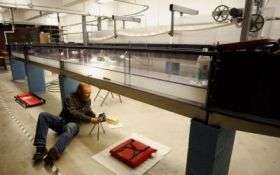
Geologists have long thought muds will only settle when waters are quiet, but new research by Indiana University Bloomington and Massachusetts Institute of Technology geologists shows muds will accumulate even when currents move swiftly. Their findings appear in this week's Science.
This may seem a trifling matter at first, but understanding the deposition of mud could significantly impact a number of public and private endeavors, from harbor and canal engineering to oil reservoir management and fossil fuel prospecting.
"Mudstones make up two-thirds of the sedimentary geological record," said IU Bloomington geologist Juergen Schieber, who led the study. "One thing we are very certain of is that our findings will influence how geologists and paleontologists reconstruct Earth's past."
Previously geologists had thought that constant, rapid water flow prevented mud's constituents -- silts and clays -- from coalescing and gathering at the bottoms of rivers, lakes and oceans. This has led to a bias, Schieber explains, that wherever mudstones are encountered in the sedimentary rock record, they are generally interpreted as quiet water deposits.
"But we suspected this did not have to be the case," Schieber said. "All you have to do is look around. After the creek on our university's campus floods, you can see ripples on the sidewalks once the waters have subsided. Closely examined, these ripples consist of mud. Sedimentary geologists have assumed up until now that only sand can form ripples and that mud particles are too small and settle too slowly to do the same thing. We just needed to demonstrate it that it can actually happen under controlled conditions."
Schieber and IU graduate student Kevin Thaisen used a specially designed "mud flume" to simulate mud deposition in natural flows. The oval-shaped apparatus resembles a race track. A motorized paddle belt keeps water moving in one direction at a pre-determined speed, say, 26 centimeters per second (about 0.6 miles per hour). The concentration of dispersed sediment, temperature, salinity, and a dozen other parameters can be controlled. M.I.T. veteran sedimentologist John Southard provided advice on the construction and operation of the mud flume used in the experiments.
For their experiments, the scientists used calcium montmorillonite and kaolinite, extremely fine clays that in dry form have the feel of facial powder. Most geologists would have predicted that these tiny mineral grains could not settle easily from rapidly moving water, but the flume experiments showed that mud was traveling on the bottom of the flume after a short time period. Experiments with natural lake muds showed the same results.
"We found that mud beds accumulate at flow velocities that are much higher than what anyone would have expected," said Schieber, who, because of the white color of the clay suspensions, calls this ongoing work the "sedimentology of milk."
The mud accumulates slowly at first, in the form of heart- or arrowhead-shaped ripples that point upstream. These ripples slowly move with the current while maintaining their overall shapes.
Understanding how and when muds deposit will aid engineers who build harbors and canals, Schieber says, by providing them with new information about the rates at which mud can accumulate from turbid waters. Taking into account local conditions, engineers can build waterways in a way that truly minimizes mud deposition by optimizing tidal and wave-driven water flow. Furthermore, Schieber explains, the knowledge that muds can deposit from moving waters could expand the possible places where oil companies prospect for oil and gas. Organic matter and muds are both sticky and are often found together.
"If anything, when organic matter is present in addition to mud, it enhances mud deposition from fast moving currents," he said.
The finding feels like something of a vindication, Schieber says. He and his colleagues have (genially) argued about whether muds could deposit from rapidly flowing water. Schieber had posited the possibility after noting an apparent oddity in the sedimentary rock record.
"In many ancient mudstones, you see not only deposition, but also erosion and rapid re-deposition of mud -- all in the same place," Schieber said. "The erosive features are at odds with the notion that the waters must have been still all or most of the time. We needed a better explanation."
Source: Indiana University


