The B-Factory Returns for its Last Hurrah
Dec 12, 2007
The B-Factory Returns for its Last Hurrah
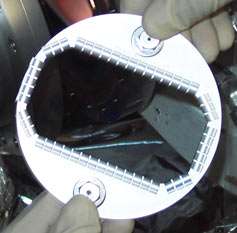
During the B-Factory's last major downtime this fall, the vacuum group replaced almost 190 RF seals with this new model in PEP-II's High Energy Ring. Credit: SLAC

This week, the B-Factory will begin running practically non-stop for 10 months, aiming for the endurance of a marathoner and the peak performance of a sprinter. Early this week, the PEP-II accelerator crew plans to begin circulating beams in the PEP rings after a three-month downtime, readying for collisions in the BaBar detector later this week.

This is the final run for the hugely successful B-Factory program, which will end on Sept. 30, 2008.

"Now that all the safety checks have been properly done, we're anxious to start up quickly and have a nice long and productive run," said John Seeman, head of the Accelerator Systems Division.

A small crew of PEP-II members, BaBar collaborators and operations staff will keep beams and data collection going throughout the SLAC holiday shutdown.

During the project's last major downtime, the PEP-II crew replaced nearly all the radio frequency (RF) seals in the accelerator.

Inside the vacuum chambers, the RF seals act like filler in sidewalk cracks, allowing the beam to smoothly traverse from one vacuum chamber to the next without depositing beam power at the joint between the two chambers. In past runs, the beam has melted the metal seals at these internal joints, which can consequently cause beam loss.

"Replacing almost 190 RF seals in the High Energy Ring [of PEP-II] was a tremendous achievement. The technicians in the Mechanical Fabrication Department produced the seals and installed them," said Run Coordinator Mike Sullivan. "We think it will greatly reduce the number of beam losses we have every day."

Even during August, the B-Factory's best month ever, the beam was lost an average of nine times a day, hurting overall data collection.

The accelerator crew also upgraded the interaction region in various ways to tolerate higher beam currents.

"We have quite ambitious goals. We're anxious to see how this machine behaves with the improvements we've put into it," Sullivan said.

On the detector side, the crew finished small-scale upgrades to enhance reliability, replaced radiation-damaged electronic components, refreshed the magnet cryogenic systems and power supply, and performed routine maintenance.

Source: by Heather Rock Woods, SLAC Today

Explore further: Physicists develop revolutionary low-power polariton laser

add to favorites email to friend print save as pdf

Related Stories

Building a better trash can

Mar 20, 2013

What does it take to create a trash can? Ask Theron Klos. He's Berkeley's central-campus grounds manager, the guy beaming like a proud parent as dozens of large, hexagon-shaped black receptacles – with ...

Out of thin air

Feb 23, 2011

Imagine a priceless painting that has been all but ruined by a ravaging storage room fire. The beautiful paint, painstakingly applied in a multitude of colors, is obscured by layers of dark soot. A masterpiece ...

Russian spacecraft lands safely after delays

Sep 25, 2010

A Russian Soyuz capsule with three crew landed safely back on Earth from the International Space Station on Saturday after unprecedented problems undocking kept astronauts an extra day in orbit.

Discovery leaves space station; next stop is Earth

Apr 18, 2010

(AP) -- Discovery and its crew left the International Space Station on Saturday and aimed for a homecoming in two days to wrap up one of the last missions of NASA's storied shuttle program.

Recommended for you

Breakthrough calls time on bootleg booze

May 20, 2013

(Phys.org) —Using a laser, the St Andrews scientists can now carry out detailed analysis of a spirit sample no bigger than a teardrop and can even confirm whether it is toxic or not. It's hoped the testing ...

Bringing life into focus

May 17, 2013

Spinning-disk confocal microscopy is an optical imaging technique that can be used to generate detailed three-dimensional fluorescence images of living cells and their contents. Although a powerful tool for ...

User comments : 0

More news stories

Making quantum encryption practical

One of the many promising applications of quantum mechanics in the information sciences is quantum key distribution (QKD), in which the counterintuitive behavior of quantum particles guarantees that no one can eavesdrop on ...

Lab sets a new record for creating heralded photons

(Phys.org) —Entanglement, by general consensus of physicists, is the weirdest part of quantum science. To say that two particles, A and B, are entangled means that they are actually two parts of an inseparable ...

If you can remember it, you can remember it wrong

(Medical Xpress)—Native peoples in regions where cameras are uncommon sometimes react with caution when their picture is taken. The fear that something must have been stolen from them to create the photo ...