December 12, 2007 weblog
Taiwan Scientists Discover Gold Nanoparticles Stabilize Organic Memory
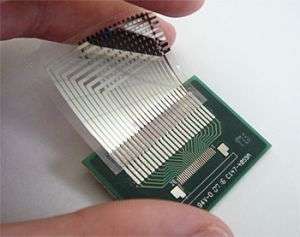
Taiwan scientists and engineers have invented a nonvolatile organic memory device. The device uses gold nanoparticles mixed with a polymer that is wedged between two aluminum electrodes.
The scientists of the National Chung Hsing University of Taiwan claim break through technology in developing a new low cost memory array 16-byte device. The collaborative efforts of University scientists and the Industrial Technology Research Institute were able to produce an organic memory device that is non-volatile.
Heretofore, engineers have endeavored to create a non volatile memory devices comprised of plastics and other carbon based chemicals. The flexible carbon organic memory is critical in the manufacturing of RFID, Smart Cards, and flexible displays for mobile phones.
The main problem engineers and scientist have encountered is the organic memory devices tend to break down in air and under stress of many read-write cycles. The breakthrough technology memory device utilizes gold nanoparticles mixed into a polymer named PCm that is wedged between two aluminum electrodes. The structure in a dormant state produces little current. However, if the voltage is pushed 2 volts, the current jumps 10,000 fold.
According to Cellular-News, the co-inventor of the process and assistant professor of electrical engineering at NCHU, Zingway Pei says that adding the gold nanoparticles made the organic memory stable and aided it in endurance of up to 1,000 switches. Pei and his colleagues theorize that the prior to reaching the threshold a small amount of electrons virtually hop from one gold nanoparticle to another. Some electrons get trapped and provide a conductive path to make the device functional . In the process smaller voltages will carry the higher current and it will begin storing current. The stored current can be wiped away by simply applying a negative voltage.
The new device can retain data for up to 10 days even if it is exposed to open air. Professor Pei believes the stability will improve and retention time should reach 30 days. The United States provided 9.1 million dollars to ITRI in March, 2007 to set up the first flexible electronics laboratory.
Other research groups are actively involved in projects involving organic nonvolatile memory devices. Some labs are exploring the use of other nanoparticles like carbon-60 that is embedded in the plastic. Others are researching the utility of plastic serving as a part of the organic transistor structure.
The new flexible organic memory device was discussed at the 2007 IEEE International Electron Devices Meeting in Washington D.C. The conference began on December 10 and will conclude December 12. According to Yu-Tzu Chiu of Spectrum On Line, the Taiwanese team consisting of NCHU and the Industrial Technology Research Institute plans to create smart cards that incorporate the new memory device. The device will be on show December 17-18 at the International Symposium for Flexible Electronics and Displays in Taiwan.


