'Wiring up' enzymes for producing hydrogen in fuel cells
Nov 19, 2007
'Wiring up' enzymes for producing hydrogen in fuel cells
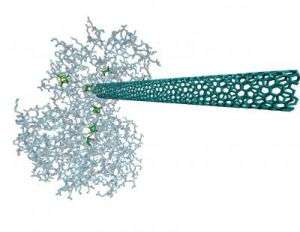
Computer graphic representation of a single-walled carbon nanotube (elongated structure) Credit: Courtesy of Michael J. Heben, National Renewable Energy Laboratory

Researchers in Colorado are reporting the first successful “wiring up” of hydrogenase enzymes. Those much-heralded proteins are envisioned as stars in a future hydrogen economy where they may serve as catalysts for hydrogen production and oxidation in fuel cells. Their report, describing a successful electrical connection between a carbon nanotube and hydrogenase, is scheduled for the Nov. issue of Nano Letters.

In the new study, Michael J. Heben, Paul W. King, and colleagues explain that bacterial enzymes called hydrogenases show promise as powerful catalysts for using hydrogen in fuel cells, which can produce electricity with virtually no pollution for motor vehicles, portable electronics, and other devices.

However, scientists report difficulty incorporating these enzymes into electrical devices because the enzymes do not form good electrical connections with fuel cell components. Currently, precious metals, such as platinum, are typically needed to perform this catalysis.

The researchers combined hydrogenase enzymes with carbon nanotubes, submicroscopic strands of pure carbon that are excellent electrical conductors. In laboratory studies, the researchers demonstrated that a good electrical connection was established using photoluminescence spectroscopy measurements.

These new “biohybrid” conjugates could reduce the cost of fuel cells by reducing or eliminating the need for platinum and other costly metal components, they say.

Source: American Chemical Society

Explore further: Scientists develop cheaper, more efficient fuel cells

add to favorites email to friend print save as pdf

Related Stories

Microwave oven cooks up solar cell material

May 06, 2013

University of Utah metallurgists used an old microwave oven to produce a nanocrystal semiconductor rapidly using cheap, abundant and less toxic metals than other semiconductors. They hope it will be used ...

New energy source for future medical implants: sugar

Jun 13, 2012

MIT engineers have developed a fuel cell that runs on the same sugar that powers human cells: glucose. This glucose fuel cell could be used to drive highly efficient brain implants of the future, which ...

Researchers harness nature to produce the fuel of the future

Jan 30, 2013

Hydrogen has tremendous potential as an eco-friendly fuel, but it is expensive to produce. Now researchers at Princeton University and Rutgers University have moved a step closer to harnessing nature to produce hydrogen for ...

Using light to remotely trigger biochemical reactions

Dec 13, 2012

(Phys.org)—Since Edison's first bulb, heat has been a mostly undesirable byproduct of light. Now researchers at Rice University are turning light into heat at the point of need, on the nanoscale, to trigger ...

Researchers build a toolbox for synthetic biology

Aug 03, 2012

For about a dozen years, synthetic biologists have been working on ways to design genetic circuits to perform novel functions such as manufacturing new drugs, producing fuel or even programming the suicide ...

Recommended for you

Scientists develop cheaper, more efficient fuel cells

1 hour ago

(Phys.org) —Using the Canadian Light Source (CLS) synchrotron, researchers have discovered a way to create cheaper fuel cells by dividing normally expensive platinum metal into nanoparticles (or even single ...

User comments : 0

More news stories

Scientists develop cheaper, more efficient fuel cells

(Phys.org) —Using the Canadian Light Source (CLS) synchrotron, researchers have discovered a way to create cheaper fuel cells by dividing normally expensive platinum metal into nanoparticles (or even single ...

Weird science: Crystals melt when they're cooled

(Phys.org) —Growing thin films out of nanoparticles in ordered, crystalline sheets, to make anything from microelectronic components to solar cells, would be a boon for materials researchers, but the physics ...

Hubble reveals the ring nebula's true shape

(Phys.org) —The Ring Nebula's distinctive shape makes it a popular illustration for astronomy books. But new observations by NASA's Hubble Space Telescope of the glowing gas shroud around an old, dying, ...

NASA head views progress on asteroid lasso mission

Surrounded by engineers, NASA chief Charles Bolden inspected a prototype spacecraft engine that could power an audacious mission to lasso an asteroid and tow it closer to Earth for astronauts to explore.

Solar Kettle allows for boiling water off the grid

(Phys.org) —A company called Contemporary Energy has unveiled a new device it calls the Solar Kettle. It looks very much like a normal coffee thermos, but has flaps on one side that open to allow for collecting ...