Pianist blends nanotechnology with music
Nov 15, 2007
Pianist blends nanotechnology with music

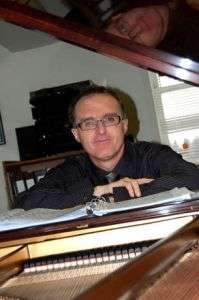
If the hard science of nanotechnology took on the soft curves of classical music, what would it sound like? The two will come together at a concert Friday, under the nimble fingers of pianist Milton Schlosser, a University of Alberta music professor.

Schlosser, based at the U of A's Augustana Faculty in Camrose, is premiering a series of 'nanosonatas' written specifically for him by American composer Frederic Rzewski. The work, entitled Nanosonatas, Volume 1, was commissioned by Schlosser through the U of A's Humanities, Fine Arts and Social Sciences Research grant program.

The composition reflects Rzewski's interest in biomolecular nanomachines. He essentially compresses the form of 20- to 40-minute, 19th-century sonatas into seven three-minute segments which challenge music-lovers in exciting new ways, Schlosser said.

"You are left having to refocus your expectations of what music is. It challenges the notion of art as always pretty," he said. "The melody becomes pin-pointed, and listeners are going to have to remember states of being, moments of sound."

Each tiny piece in the 21-minute work stores a wealth of musical ideas. It is challenging to perform, he admits. Not surprisingly, "every note counts."

The nano-notes are inspired by a friendship Rzewski struck up with a physicist who also happened to be an amateur pianist. Rzewski, who will visit Augustana Campus in February, set out to compose a reflective piece after his physicist friend showed him a video of a rotating nanomotor - a device that is 300 to 500 times smaller than the width of a hair.

"In terms of sound, the music of the first nanosonata imitates the changing pace of the nanomotor," Schlosser said. He describes the entire collection of nanosonatas as avant-garde with a touch of the abstract.

The blending of technology and music bridges the chasm between art and science, Schlosser said. "It also shows on a human level that technology has to have its expression in the arts as well."

Source: University of Alberta

Explore further: US: NYU researchers took bribes from Chinese group

add to favorites email to friend print save as pdf

Related Stories

Origins of human culture linked to rapid climate change

31 minutes ago

Rapid climate change during the Middle Stone Age, between 80,000 and 40,000 years ago, during the Middle Stone Age, sparked surges in cultural innovation in early modern human populations, according to new research.

NGOs denounce Malaysia hydropower meeting

1 hour ago

Three dozen Malaysian NGOs on Tuesday denounced the world hydroelectric industry's decision to hold a conference in a Borneo state where dam projects have uprooted forests and native peoples.

Recommended for you

US: NYU researchers took bribes from Chinese group

May 20, 2013

Three New York University researchers from China divulged results from a U.S.-funded study to Chinese competitors in exchange for tuition, rent and other expenses, federal prosecutors said Monday.

US scientist not involved in classified research: witnesses

May 17, 2013

Colleagues of a US scientist found hanged in Singapore last year told a coroner's inquiry Friday he was not involved in projects with military applications and was never asked to compromise any country's national security.

User comments : 0

More news stories

The new retirement: No retirement?

For growing numbers of Americans, the new retirement may really mean no retirement. That's the conclusion of an article in the current issue of the ISR Sampler, the annual magazine of the University of Michigan Institute ...

Striking a balance on taxes

Now that April 15 has come and gone, most Americans have turned their attention away from taxes. But MIT student Stefanie Stantcheva continues to ponder the trade-offs associated with taxation.

Social media puts HR ethics under the spotlight

Social media has definitely changed the game for job-seekers and recruiters. Traditionally, HR recruiters placed an advertisement, sifted through the responses, and interviewed the shortlisted candidates ...

Theorists weigh in on where to hunt dark matter

(Phys.org) —Now that it looks like the hunt for the Higgs boson is over, particles of dark matter are at the top of the physics "Most Wanted" list. Dozens of experiments have been searching for them, but ...

DNA damage: The dark side of respiration

(Phys.org) —Adventitious changes in cellular DNA can endanger the whole organism, as they may lead to life-threatening illnesses like cancer. Researchers at LMU now report how byproducts of respiration cause mispairing ...