Exactly how sensitive is our climate? It may not matter...
Oct 26, 2007
Exactly how sensitive is our climate? It may not matter...
Fixing carbon dioxide targets too early in the process of climate change could be dangerous, according to Oxford University researchers.

Scientists from Oxford University have suggested that climate researchers and policy makers ought to worry less about working out exactly how sensitive Earth's climate will be to a doubling of carbon dioxide in the atmosphere.

In this week's Science, Dr Myles Allen and Dr Dave Frame argue that while placing an upper limit on climate sensitivity is difficult, it may also be much less relevant to policy than is usually assumed. Dr Allen and Dr Frame’s article accompanies a paper by Gerard Roe and Marcia Baker that shows it will remain difficult to infer a robust distribution for climate sensitivity from any observations we can make of current climate.

‘No one denies that quantifying climate system feedbacks is a crucial part of our attempts to understand the climate change problem,’ said Dr Myles Allen of Oxford University's Department of Physics, ‘but putting an upper bound on climate sensitivity has become something of a Holy Grail for climate researchers. What we are suggesting is that this may not be possible or very helpful.'

Uncertainties in how climate processes feed into one another are partly to blame, as are the different statistical methods that could be used to calculate such an upper limit. If the world really does warm by 4 degrees Celsius or more the climate will be so different from what we know today that predicting when this warming will stop is all but impossible. Dr Allen and Dr Frame believe that, in trying to define an upper limit, climate modellers have to make too many assumptions about what is likely to happen – assumptions that are impossible to test.

'The only way our descendants would find out if the climate sensitivity is really as high as 5 degrees Celsius is to stubbornly hold greenhouse gas concentrations constant for centuries at a specified target level,' said Dr Frame, who is based in the Oxford University Centre for the Environment. 'In reality our descendants will continually revise their targets for atmospheric carbon dioxide concentrations in the light of the climate changes they actually observe.'

The real danger, Drs Allen and Frame suggest, comes from trying to fix a target concentration of carbon dioxide too early in the process of climate change and not adapting as new observations come along. Dr Allen comments: 'providing our descendants have the good sense to adapt their policies to the emerging climate change signal they probably won't care about how sensitive our climate is because they will have been smart enough to limit the damage.'

The development of more adaptive climate policy frameworks has support from other quarters, too. Gary Yohe, Woodhouse/Sysco Professor of Economics at Wesleyan University, said: ‘Climate policies must be predictable, but they must also adjust to new information: the challenge is to design a transparent process whereby climate policies can be adjusted in the light of genuinely new information without becoming subject to political whims.’

The perspectives article, entitled ‘Call off the quest’, by Dr Myles Allen and Dr Dave Frame is published in Science on 26 October 2007.

Source: Oxford University

Explore further: Astonishing hi-resolution satellite views of the destruction from the Moore, Oklahoma tornado

add to favorites email to friend print save as pdf

Related Stories

Sophisticated simulations predict future warming

May 22, 2012

The chances of our planet being hit by a global warming of 3 degrees Celsius by 2050 is as likely as it being hit by an increase of 1.4 degrees, new research shows. Presented in the journal Nature Geoscience, the British study ...

Save 'trillionth tonne' warn Oxford scientists

Apr 30, 2009

(PhysOrg.com) -- Emitting carbon dioxide slower will not prevent dangerous climate change unless it involves phasing out carbon dioxide emissions altogether, before we reach an upper limit of one trillion ...

Recommended for you

Strong earthquake at exceptional depth

May 24, 2013

This morning at 05:45 CEST, the earth trembled beneath the Okhotsk Sea in the Pacific Northwest. The quake, with a magnitude of 8.2, took place at an exceptional depth of 605 kilometers. Because of the great ...

Marine forecasting on the horizon for Indian Ocean Rim

May 24, 2013

Nearly all of the member countries of the Indian Ocean Rim Association for Regional Cooperation (IOR-ARC) will attend the week-long workshop to further cooperation and understanding on international ocean ...

Russia evacuates drifting Arctic research station

May 23, 2013

Russia has ordered the urgent evacuation of the 16-strong crew of a drifting Arctic research station after ice floe that hosts the floating laboratory began to disintegrate, officials said Thursday.

User comments : 4

Adjust slider to filter visible comments by rank

Display comments: newest first

SDMike
4 / 5 (3) Oct 26, 2007
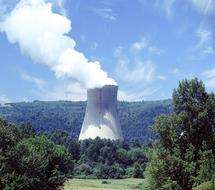
And so a photo of a COOLING TOWER emitting water vapor illustrates CO2???? It's probably a nuclear power plant. Linked to setting co2 targets how???
fredrick
2 / 5 (2) Oct 26, 2007
how can you be sure that's a nuclear power plant? The rest of it might be hidden behind the tree...

And besides which, the article was mainly about estimating climate change sensitivity, not CO2 emmisions. The picture has nothing really to do with what the article says, its just an iconic picture of a power plant's cooling tower - which is most often associated with CO2 rises, as most people don't know that it is the smoke stacks which emit the really bad stuff.

Or one could argue that water vapor IS a greenhouse gas, so I guess that does contribute too. But really I think its just a picture, and quite a lot of the pictures in news articles only have loose connections to the subject - can you draw a picture of climate change sensitivity?
Argiod
2.3 / 5 (3) Oct 27, 2007
"...the challenge is to design a transparent process whereby climate policies can be adjusted in the light of genuinely new information without becoming subject to political whims..."

Yeah, right. And if I had a square ass, I'd shit cubes!
lengould100
not rated yet Apr 30, 2009
Agreed, the nuclear plant's cooling tower was the first thing i noticed at the top, and i was hunting for any relationship all through the article. Very distracting.

More news stories

Galaxies fed by funnels of fuel

(Phys.org) —Computer simulations of galaxies growing over billions of years have revealed a likely scenario for how they feed: a cosmic version of swirly straws.

Century-old science helps confirm global warming

(Phys.org) —Ocean measurements taken more than 135 years ago during the scientific expedition of HMS Challenger have provided further confirmation of human-produced global warming over the past century.