New study uncovers secrets behind butterfly wing patterns
Oct 25, 2007
New study uncovers secrets behind butterfly wing patterns
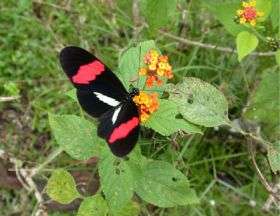
Heliconius Erato: A Heliconius butterfly in Panama

The genes that make a fruit fly's eyes red also produce red wing patterns in the Heliconius butterfly found in South and Central America, finds a new study by a UC Irvine entomologist.

Bob Reed, assistant professor of ecology and evolutionary biology, discovered that genes involved in making insect eye pigments evolved over time to also make wing pigments in butterflies. This finding sheds light on the genetic causes of wing patterns and why, in the Heliconius, those patterns can vary widely from region to region.

"We found that evolution is achieved primarily through recycling old genes into new functions, as opposed to evolving entirely new genes from scratch," Reed said.

Results of the study appear online this week in the Proceedings of the Royal Society B.

Within one species of the butterfly genus Heliconius, more than 20 distinct wing patterns can exist in different geographic regions. Over time, the Heliconius evolves to look like local unrelated butterfly species that are poisonous to birds, a phenomenon called mimicry.

"It is a very basic textbook example of natural selection," Reed said. "If you look like you're poisonous, you're not going to get eaten and you can produce offspring."

Reed's study also explains under which conditions certain genes will cause a stripe on a Heliconius wing to become yellow or red.

W. Owen McMillan of the University of Puerto Rico and Lisa M. Nagy of the University of Arizona also worked on this study, which was funded by the National Science Foundation and a University of Arizona IGERT genomics fellowship.

UC Irvine has two additional butterfly experts -- Adriana Briscoe, who studies butterfly eyes and color vision, and Tony Long, who studies eyespot patterns on butterfly wings. All three scientists are members of the Department of Ecology and Evolutionary Biology in the School of Biological Sciences.

Source: University of California - Irvine

Explore further: New evidence suggests some birds gave up flight to become better swimmers

add to favorites email to friend print save as pdf

Related Stories

How the butterflies got their spots

Feb 05, 2010

(PhysOrg.com) -- How two butterfly species have evolved exactly the same striking wing colour and pattern has intrigued biologists since Darwin's day. Now, scientists at Cambridge have found 'hotspots' in ...

'Supergene' is key to copycat butterflies

Aug 12, 2011

Since Charles Darwin, biologists have pondered the mystery of "mimicry butterflies", which survive by copying the wing patterns of other butterflies that taste horrible to their predators, birds.

An eye gene colors butterfly wings red

Jul 21, 2011

Red may mean STOP or I LOVE YOU! A red splash on a toxic butterfly's wing screams DON'T EAT ME! In nature, one toxic butterfly species may mimic the wing pattern of another toxic species in the area. By ...

Recommended for you

New method for assessing future tree and plant disease risks

4 hours ago

A new method for assessing the impacts and risks of potential future tree and plant pest and disease outbreaks has been developed by the University's Professor Robert Fraser as one of the key recommendations of the government ...

Slow pokes: Acupuncture helps hypothermic turtles

5 hours ago

Two endangered sea turtles that are shells of their former selves after getting stranded on Cape Cod during a cold spell are getting some help easing back into the wild—from an acupuncturist.

User comments : 0

More news stories

Slow pokes: Acupuncture helps hypothermic turtles

Two endangered sea turtles that are shells of their former selves after getting stranded on Cape Cod during a cold spell are getting some help easing back into the wild—from an acupuncturist.

Study shows where scene context happens in our brain

In a remote fishing community in Venezuela, a lone fisherman sits on a cliff overlooking the southern Caribbean Sea. This man –– the lookout –– is responsible for directing his comrades on the water, ...

New rice contamination reported in China

Authorities are investigating rice mills in southern China following tests that found almost half of the staple grain in one of the country's largest cities was contaminated with a toxic metal.