Double Star TC-1 completes its mission
Oct 16, 2007
Double Star TC-1 completes its mission
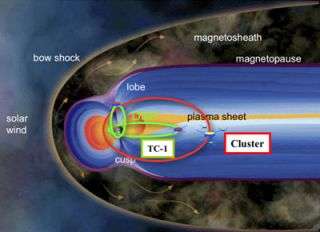
The orbits of Cluster (in red) and Double Star (in green) are illustrated in the picture. The background shows Earth's magnetic environment. On of the twin satellites of the Double Star programme (DSP), TC-1 will be decommissioned today. Credits: ESA

TC-1, one of the two satellites of the CNSA/ESA Double Star mission, was decommissioned on 14 October as its designed orbit lifetime came to an end. The satellite re-entered Earth’s atmosphere and turned to dust during its descent.

Along with its twin TC-2, TC-1 is the first satellite built and operated by the Chinese National Space Administration (CNSA) in cooperation with ESA. Along with its twin and the four Cluster satellites, TC-1 has helped accomplish much during its lifetime.

The four years during which Double Star was operational brought in new perspectives concerning the boundaries of the magnetosphere and the fundamental processes that are playing a role in the transport of mass, momentum and energy into the magnetosphere. Thanks to the measurements of TC-1, there was a chance to observe the evolution of structures and physical processes at small scales with Cluster, and then on large scales with Double Star.

Here we list some of the most interesting results where TC-1 played a crucial role.

Space is fizzy

Above our heads, at the bow shock, where the Earth’s magnetic field meets the constant stream of gas from the Sun, thousands of bubbles of superheated gas, or ion density holes, are constantly growing and popping. These bubbles were discovered by Cluster and Double Star together, and the discovery allowed scientists to better understand the interaction between the solar wind and the Earth’s magnetic field.

Celestial chorus further away

Chorus emissions are waves naturally generated in space close to the magnetic equator. They play an important role in creating killer electrons that can damage solar panels and electronic equipments of satellites and are a hazard for astronauts. It was found that these waves are created further away from Earth during high geomagnetic activity. This information is crucial to be able to forecast their impact.

Oscillations of Earth’s natural cloak of magnetism

The four Cluster satellites and TC-1 unexpectedly found themselves engulfed by waves of electrical and magnetic energy as they travelled through Earth’s night-time shadow. Something had set the tail of Earth’s natural cloak of magnetism oscillating, like waves created by a boat travelling across a lake. The data collected gave scientists an important clue to the effects of space weather on Earth’s magnetic field.

"Double Star has demonstrated mutual benefit and fostered scientific cooperation in space research between China and Europe. But there is still much more to come as the full, high-resolution data archive becomes available," says Philippe Escoubet, ESA’s Cluster and Double Star Project Scientist.

Source: European Space Agency

Explore further: NASA head views progress on asteroid lasso mission

add to favorites email to friend print save as pdf

Related Stories

Pandora posts in-line 1Q loss, upbeat sales

11 hours ago

(AP)—Internet radio company Pandora reported higher-than-expected revenue in the latest quarter, with losses in line with analysts' forecasts, as the number of subscribers who pay for ad-free listening rose above 2.5 million.

Google Drive sports new view and scan enhancements

11 hours ago

(Phys.org) —Google Drive has a new look and functions. The makeover in Google Drive features scanning and interface enhancements that put the user into "card" mode. The enhancements make it easy for the ...

Researcher admits mistakes in stem cell study

11 hours ago

A blockbuster study in which US researchers reported that they had turned human skin cells into embryonic stem cells contained errors, its lead author has acknowledged. ...

Recommended for you

Dark, massive asteroid to fly by Earth on May 31

2 hours ago

It's 1.7 miles long. Its surface is covered in a sticky black substance similar to the gunk at the bottom of a barbecue. If it impacted Earth it would probably result in global extinction. Good thing it is ...

Research team explains 'Lazarus' comets

6 hours ago

Astronomers from the University of Antioquia have discovered a graveyard of comets. These once-dormant comets, dubbed by astronomers as "The Lazarus comets," are now rejuvenated.

NASA ships sensors for seafaring satellite to France

6 hours ago

(Phys.org) —Three NASA-built instruments that are integral components of the next in a series of U.S./European ocean altimetry satellites have arrived in France for integration with their spacecraft in ...

Trip into space with DiCaprio costs $1.55m

7 hours ago

Leonardo DiCaprio is going to get closer to stars of a different kind as he heads into space aboard the Virgin Galactic, and a well-heeled bidder at the Cannes Film Festival has paid 1.2 million euros (1.5 million) to be ...

User comments : 0

More news stories

Dark, massive asteroid to fly by Earth on May 31

It's 1.7 miles long. Its surface is covered in a sticky black substance similar to the gunk at the bottom of a barbecue. If it impacted Earth it would probably result in global extinction. Good thing it is ...

Source of life running out: water scientists

The majority of people on Earth people will face severe water shortages within a generation or two if pollution and waste continues unabated, scientists warned at a conference in Bonn Friday.

Facial-recognition technology proves its mettle

(Phys.org) —In a study that evaluated some of the latest in automatic facial recognition technology, researchers at Michigan State University were able to quickly identify one of the Boston Marathon bombing ...