Developing a modular, nanoparticle drug delivery system
There are two aspects to creating an effective drug: finding a chemical compound that has the desired biological effect and minimal side-effects and then delivering it to the right place in the body for it to do its job.
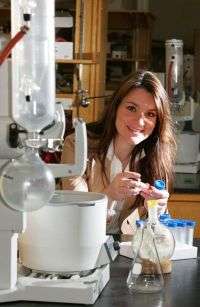
With the support from a $478,000, five-year CAREER award from the National Science Foundation, Eva Harth is tackling the second part of this problem. She is creating a modular, multi-functional drug delivery system that promises simultaneously to enhance the effectiveness and reduce undesirable side-effects of a number of different drugs.
Harth, who is an assistant professor of chemistry at Vanderbilt University, has created a “nanosponge” specially designed to carry large numbers of drug molecules. She has also discovered a “molecular transporter” that, when attached to the nanosponge, carries it and its cargo across biological barriers into specific intracellular compartments, which are very difficult places for most drugs to reach. She has shown that her system can reach another difficult target: the brain. Experiments have shown that it can pass through the brain-blood barrier. In addition, she has: successfully attached a special “targeting unit” that delivers drugs to the surface of tumors in the lungs, brain and spinal cord and even developed a “light kit” for her delivery system – fluorescent tags that researchers can use to monitor where it goes.
Harth has taken a different approach from other researchers working on nanotechnology for drug development. Instead of trying to encapsulate drugs in nanoscale containers, she decided to create a nanoparticle that had a large number of surface sites where drug molecules could be attached. To do so, she adopted a method that uses extensive internal cross-linking to scrunch a long, linear molecule into a sphere about 10 nanometers in diameter, about the size of a protein. Nanoparticles like this are called nanosponges.
“We can really load this up with a large number of drug molecules,” she says.
Working with Heidi Hamm, the Earl W. Sutherland Jr. Professor of Pharmacology at Vanderbilt, Harth synthesized a dendritic molecule with the ability to slip through cell membranes and reach the cell nucleus. They figured out how to attach this “transporter” to her nanoparticle and showed that the transporter can pull the nanoparticle after it into cellular compartments. They also demonstrated that the transporter can deliver large molecules – specifically peptides and proteins – into specific sub-cellular locations.
“Peptides and proteins can act as drugs, just like smaller molecules,” Harth says. “However, there is not much activity in this area because people haven’t had a method for getting them into cells. Now that there is a way to do it, but that may change.”
Hamm studies G proteins, arguably the most important signaling molecules in the cell. Scientists think that many diseases, including diabetes and certain forms of pituitary cancer, are caused by malfunctioning G proteins. She and Harth are collaborating on using the transporter to deliver peptides produced by G proteins that disrupt signaling pathways.
“Eva’s methods for drug delivery are very novel and versatile and can be adapted to delivery of proteins, peptides, DNA and smaller chemical compounds like most drugs. The breadth of applications makes her technology very powerful,” Hamm says.
The chemist is also collaborating with Dennis E. Hallahan, professor of radiation oncology at Vanderbilt, to apply the drug delivery system to fighting cancer. Hallahan’s lab had identified a molecule that targets a surface feature on lung carcinomas. Harth took the molecule, improved it, attached it to her nanoparticle and the two of them determined that the combination is capable of delivering drugs to the surface of lung tumors.
She is now working with Hallahan to adapt her delivery system to carry cisplatinum, a traditional chemotherapy agent that is used to treat a number of different kinds of cancer but is highly toxic and has a number of unpleasant side effects.
By delivering the anti-cancer agent directly to the cancerous tissues, Eva’s system decreases the adverse effects on other tissues and increases its potency by delivering a higher concentration of the drug directly on the cancer, Hallahan explains.
“The people in my lab have tried at a number of different drug delivery systems and Eva’s works the best of those we’ve looked at,” Hallahan says.
Vanderbilt is applying for two patents on the system.
Source: Vanderbilt University


