Researchers shed light on light-emitting nanodevice
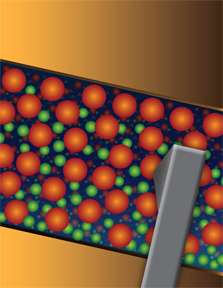
Top view of the ruthenium tris-bipyridine light-emitting device created by Cornell researchers. The ruthenium metal complex is represented by red spheres, and counter ions are represented by green spheres. The material is sandwiched between two gold electrodes. Also visible is the probe of the electron force microscope used to measure the electric field of the device. Source: CU
An interdisciplinary team of Cornell nanotechnology researchers has unraveled some of the fundamental physics of a material that holds promise for light-emitting, flexible semiconductors. The discovery, which involved years of perfecting a technique for building a specific type of light-emitting device, is reported in the Sept. 30 online publication of the journal Nature Materials.
The interdisciplinary team had long studied the molecular semiconductor ruthenium tris-bipyridine. For many reasons, including its ability to allow electrons and holes (spaces where electrons were before they moved) to pass through it easily, the material has the potential to be used for flexible light-emitting devices. Sensing, microscopy and flat-panel displays are among its possible applications.
The researchers set out to understand the fundamental physics of the material -- that is, what happens when it encounters an electric field, both at the interfaces and inside the film. By fabricating a device out of the ruthenium metal complex that was spin-coated onto an insulating substrate with pre-patterned gold electrodes, the scientists were able to use electron force microscopy to measure directly the electric field of the device.
A long-standing question, according to George G. Malliaras, associate professor of materials science and engineering, director of the Cornell NanoScale Science and Technology Facility and one of the co-principal investigators, was whether an electric field, when applied to the material, is concentrated at the interfaces or in the bulk of the film.
The researchers discovered that it was at the interfaces -- two gold metal electrodes sandwiching the ruthenium complex film -- which was a huge step forward in knowing how to build and engineer future devices.
"So when you apply the electric field, ions in the material move about, and that creates the electric fields at the interfaces," Malliaras explained.
Essential to the effort was the ability to pattern the ruthenium complex using photolithography, a technique not normally used with such materials and one that took the researchers more than three years to perfect, using the knowledge of experts in nanofabrication, materials and chemistry.
The patterning worked by laying down a gold electrode and a polymer called parylene. By depositing the ruthenium complex on top of the parylene layer and filling in an etched gap between the gold electrodes, the researchers were then able to peel the parylene material off mechanically, leaving a perfect device.
Ruthenium tris-bipyridine has energy levels well suited for efficient light emission of about 600 nanometers, said Héctor D. Abruña, the E.M. Chamot Professor of Chemistry, and a principal co-investigator. The material, which has interested scientists for many years, is ideal for its stability in multiple states of oxidation, which, in turn, allows it to serve as a good electron and hole transporter. This means that a single-layer device can be made, simplifying the manufacturing process.
"It's not fabulous, but it has a reasonable emission efficiency," Abruña said. "One of the drawbacks is it has certain instabilities, but we have managed to mitigate most of them."
Among the other authors were co-principal investigators Harold G. Craighead, the C.W. Lake Jr. Professor of Engineering, and John A. Marohn, associate professor of chemistry and chemical biology.
Source: Cornell University
-
From lemons to lemonade: Reaction uses carbon dioxide to make carbon-based semiconductor,
33 comments
-
Thioridazine kills cancer stem cells in human while avoiding toxic side-effects of conventional cancer treatments,
3 comments
-
SpaceX private rocket blasts off for space station (Update),
42 comments
-
Landmark calculation clears the way to answering how matter is formed,
55 comments
-
Research team claims to have found evidence Lake Cheko is impact crater for Tunguska Event,
18 comments
-
How to determine the flexural rigidity of a composite
8 hours ago
-
microstructure of titanium
May 26, 2012
-
Steam in My Espresso Machine
May 26, 2012
-
Density question
May 24, 2012
-
Mass transport originating from a point source at a solid gas interface
May 22, 2012
-
Ammonia dispersion in Air
May 22, 2012
- More from Physics Forums - Materials & Chemical Engineering
More news stories
Stunning image of smallest possible five-ringed structure
Scientists have created and imaged the smallest possible five-ringed structure about 100,000 times thinner than a human hair and you'll probably recognise its shape.
5 hours ago |
4.4 / 5 (5) |
1
|
'Unzipped' carbon nanotubes could help energize fuel cells, batteries
Multi-walled carbon nanotubes riddled with defects and impurities on the outside could replace some of the expensive platinum catalysts used in fuel cells and metal-air batteries, according to scientists at ...
Nanotechnology / Nanomaterials
11 hours ago |
3 / 5 (2) |
0
|
Dopant gives graphene solar cells highest efficiency yet
(Phys.org) -- By taking advantage of graphenes favorable electrical and optical properties, and then adding an organic dopant, researchers have achieved the highest power conversion efficiency yet for ...
In nanorod crystal growth, nanoparticles seen as artificial atoms
In the growth of crystals, do nanoparticles act as "artificial atoms" forming molecular-type building blocks that can assemble into complex structures? This is the contention of a major but controversial theory ...
May 24, 2012 |
4.8 / 5 (6) |
0
|
First direct observation of oriented attachment in nanocrystal growth
Berkeley Lab researchers have reported the first direct observation of nanoparticles undergoing oriented attachment, the critical step in biomineralization and the growth of nanocrystals. A better understanding ...
May 24, 2012 |
4.7 / 5 (3) |
0
|
Change in developmental timing was crucial in the evolutionary shift from dinosaurs to birds: study
At first glance, it's hard to see how a common house sparrow and a Tyrannosaurus Rex might have anything in common. After all, one is a bird that weighs less than an ounce, and the other is a dinosaur that ...
Computer model used to pinpoint prime materials for efficient carbon capture
When power plants begin capturing their carbon emissions to reduce greenhouse gases and to most in the electric power industry, it's a question of when, not if it will be an expensive undertaking.
T cells 'hunt' parasites like animal predators seek prey, study shows
By pairing an intimate knowledge of immune-system function with a deep understanding of statistical physics, a cross-disciplinary team at the University of Pennsylvania has arrived at a surprising finding: T cells use a movement ...
Yale study concludes public apathy over climate change unrelated to science literacy
Are members of the public divided about climate change because they don't understand the science behind it? If Americans knew more basic science and were more proficient in technical reasoning, would public consensus match ...
Land and sea species differ in climate change response: study
(Phys.org) -- Marine and terrestrial species will likely differ in their responses to climate warming, new research by Simon Fraser University and Australia’s University of Tasmania has found.
10 million years needed to recover from mass extinction
It took some 10 million years for Earth to recover from the greatest mass extinction of all time, latest research has revealed.