SOHO Mission Discovers Rare Comet
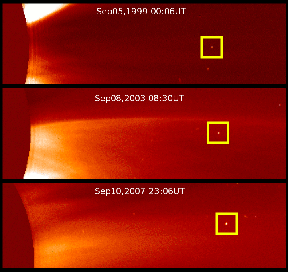
The Solar and Heliospheric Observatory (SOHO) has discovered a rare periodic comet. SOHO has already discovered more than 1,350 comets during its mission, but this is the first time one of its discoveries officially has been designated periodic.
Many of the comets SOHO has discovered are believed to be periodic, meaning they follow their orbits around the sun more than twice and have orbital periods of less than 200 years. Thousands of comets have been seen by astronomers, but only around 190 are classified as periodic. The most famous periodic comet is Halley’s Comet, which returns every 76 years. It most recently passed close to the sun in 1986.
SOHO’s new find has a much smaller orbit than Halley's Comet. It takes the comet approximately four years to travel once around the sun. It was first seen in September 1999 and then again in September 2003. In 2005, German PhD student Sebastian Hoenig realized that the two comets were so similar in orbit that they might actually be the same object. To test his theory, he calculated a combined orbit for the comet and consequently predicted that it would return on Sept. 11, 2007. Hoenig's prediction proved to be extremely accurate -- the comet reappeared in SOHO's Large Angle and Spectrometric Coronagraph camera right on schedule and has now been given the official designation of P/2007 R5 (SOHO). Credit for the original discovery and recovery of the object goes to Terry Lovejoy (Australia, 1999), Kazimieras Cernis (Lithuania, 2003) and Bo Zhou (China, 2007).
A puzzling aspect to P/2007 R5 (SOHO) is that it does not look exactly like a comet. It has no visible tail or coma of dust and gas, as is traditionally associated with the phenomena. Initially, this led some scientists to wonder if the object was actually an asteroid, a chunk of space-rock, rather than a chunk of space-ice. However, P/2007 R5 (SOHO) did exhibit some characteristics consistent with a comet. As scientists watched the object pass close to the sun, drawing to within 4.9 million miles, or around 5% of the distance between the Earth and the sun, they saw it brighten by a factor of around a million, which is common behavior for a comet.
“It is quite possibly an extinct comet nucleus of some kind,” says Karl Battams of the Naval Research Laboratory, Washington, who runs SOHO's comet discovery program. Extinct comets have expelled most of their volatile ices and retain little to form a tail or coma. They are theorized to be common objects among the celestial bodies orbiting close to the sun.
This comet faded as quickly as it brightened, and soon became too faint for SOHO's instruments to see. Estimates show that P/2007 R5 (SOHO) is probably only 100 to 200 yards in diameter. Given how small and faint this object is, and how close it still is to the sun, it is an extremely difficult target for observers on Earth to pick out in the sky.
Now we know for certain that P/2007 R5 (SOHO) is there, astronomers will be watching closely for it during its next return in September 2011.
Source: Stuart Clark, European Space Agency


