Antarctic plants and animal life survived ice ages
Sep 27, 2007
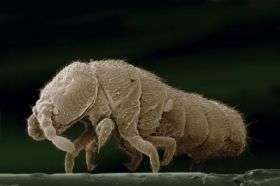
Antarctic Springtail
Antarctic springtail - Cryptopygus antarcticus. False colour, scanning electron-micrograph. Cryptopygus is one of the most successful terrestrial arthropods to have colonised the Antarctic continent. Although only 1-2 mm long and weighing only a few micro-grams, it is one of the largest animals to complete its lifecycle on the Antarctic continent. Credit: Pete Bucktrout

Springtails, mites, worms and plant life could help solve the mystery of Antarctica’s glacial history according to new research published in the journal Science this week.

Scientists from British Antarctic Survey (BAS) and Massey University New Zealand report that of the evolutionary history of Antarctica’s terrestrial plant and animal life does not reconcile with current reconstructions of past glacial ice extent going back more than 23 million years.

In today’s warm period less than 1 percent of Antarctica is ice-free. It has been assumed that during ice ages there was insufficient ice-free land for Antarctic plant and animal species to survive and evolve. However scientists report that an exceptional long-term evolutionary persistence, isolation, and a striking capability to survive global climate change, appear to be the ‘norm’ rather than the exception for the terrestrial world.

Pete Convey of BAS said, ‘Because these groups of invertebrates, plants and microbes occupy such a tiny part of a huge continent climate scientists have tended to ignore them. But recent advances in molecular biology and biogeography show us that they are indeed significant when you are trying to reconstruct a picture of the Earth’s glacial history. It is important now for us to work together with scientists from all disciplines to integrate this new biological evidence in glaciological and climate models. It will help answer the big global questions about past and future climate change and be a valuable contribution to International Polar Year 2007-2008.’

Source: British Antarctic Survey

Explore further: NASA's Landsat satellite looks for a cloud-free view

add to favorites email to friend print save as pdf

Related Stories

Dead seals serve conservation boost

Mar 05, 2013

Scientists have used genetic testing on animals that died of natural causes for the first time, potentially boosting efforts to save endangered species.

Recommended for you

NASA's Landsat satellite looks for a cloud-free view

3 hours ago

For decades, Landsat satellites have documented the desiccation of the Aral Sea in Central Asia. Once one of the largest seas in the world, it shrunk to a tenth of its original volume after Russia diverted ...

Volcanoes cause climate gas concentrations to vary

11 hours ago

Trace gases and aerosols are major factors influencing the climate. With the help of highly complex installations, such as MIPAS on board of the ENVISAT satellite, researchers try to better understand the ...

Explainer: Why are tornadoes so destructive?

12 hours ago

Tornadoes are a part of life for people living in the Great Plains of the United States. In Oklahoma, a state that averages 62 tornadoes a year, people are prepared as best as they can be and are well warned.

User comments : 0

More news stories

Forecast for Titan: Wild weather could be ahead

(Phys.org) —Saturn's moon Titan might be in for some wild weather as it heads into its spring and summer, if two new models are correct. Scientists think that as the seasons change in Titan's northern hemisphere, ...

SDO observes mid-level solar flare

UPDATE 16:30 p.m. EDT: The M7-class flare was also associated with a coronal mass ejection or CME, another solar phenomenon that can send billions of tons of particles into space. While this CME was not Ea ...

NASA's Landsat satellite looks for a cloud-free view

For decades, Landsat satellites have documented the desiccation of the Aral Sea in Central Asia. Once one of the largest seas in the world, it shrunk to a tenth of its original volume after Russia diverted ...