VLT interferometer detects disc around aged star
September 27, 2007

VLT interferometer detects disc around aged star

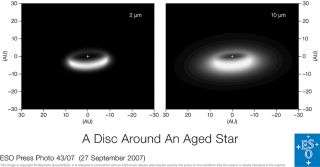
Astronomers have used ESO's Very Large Telescope Interferometer and its razor sharp eyes to discover a reservoir of dust trapped into a disc that surrounds an elderly star. Here, model images of the disc of dust around the aged star, V390 Velorum, as inferred from observations taken with ESO's powerful interferometric instruments, Astronomical Multi-BEam combineR (AMBER) and MID-infrared Interferometric instrument (MIDI), at the Very Large Telescope Interferometer, are shown at two different wavelengths (2 microns, left panel; 10 microns, right panel). The observations reveal a disc with a much puffed-up inner rim, extending from 9 Astronomical Units to several hundreds of AU. The giant star, whose position is indicated by the cross in the images, is 5000 times as bright as our Sun and is located 2,600 light-years away from Earth. The brightest region is the inner wall on the far side. Credit: ESO

A team of European astronomers has used ESO's Very Large Telescope Interferometer and its razor-sharp eyes to discover a reservoir of dust trapped in a disc that surrounds an elderly star. The discovery provides additional clues about the shaping of planetary nebulae.

In the last phases of their life, stars such as our Sun evolve from a red giant which would engulf the orbit of Mars to a white dwarf, an object that is barely larger than the Earth. The transition is accomplished by the shedding of a huge envelope of gas and dust that sparkles in many colours, producing a most spectacular object: a planetary nebula. The celestial chrysalis becomes a cosmic butterfly.

This metamorphosis, rapid in terms of the star's lifetime, is rather complex and poorly understood. In particular, astronomers want to understand how a spherical star can produce a great variety of planetary nebulae, some with very asymmetrical shapes.

A team of scientists therefore embarked upon the study of a star which is presently on its way to becoming a cosmic butterfly. The star, V390 Velorum, is 5000 times as bright as our Sun and is located 2,600 light-years away. It is also known to have a companion that accomplishes its ballet in 500 days.

Astronomers postulate that elderly stars with companions possess a reservoir of dust that is thought to play a lead role in the final chapters of their lives. The shape and structure of these reservoirs remain, however, largely unknown.

To scrutinise the object with great precision, the astronomers linked observations taken with ESO's powerful interferometric instruments, AMBER and MIDI, at the Very Large Telescope Interferometer. In particular, they combined, using AMBER, the near-infrared light of three of VLT's 8.2-m Unit Telescopes. "Only this triple combination of powerful telescopes allows us to pinpoint the position and the shape of the dusty reservoir on a milli-arcsecond scale," explains Pieter Deroo, lead-author of the paper that presents these results in the research journal Astronomy and Astrophysics.

These observations clearly demonstrate that the dust present around the star cannot be distributed in a spherical shell. "This shows that whatever mechanism is shaping asymmetric planetary nebulae is already present prior to the metamorphosis taking place," says Hans Van Winckel, member of the team.

The astronomers found indeed evidence for a disc extending from 9 Astronomical Units to several hundreds of AU. "This disc is found around a star that is in a very brief phase of its life - just a blink of an eye over the star's lifespan of billions of years - but this phase is very important," says Deroo. "It is in this period that a huge morphological change occurs, leading to the creation of a planetary nebula," he adds.

The very high spatial resolution measurements allowed the astronomers to decouple the unresolved contribution of the central star from the resolved disc emission. Even the very inner structure of the disc as well as its orientation and inclination could be determined. The observations probe the physical nature of the disc and reveal that the dust in the inner rim is extremely hot and puffed up. The disc is circumbinary as it surrounds both stars.

Dust processing (coagulation, crystallisation) is found to be very efficient in this circumbinary disc, despite the rather short evolutionary timescales involved. The disc around this evolved object is very similar to those around young stellar objects, in which planets are formed.

"The combination of MIDI and AMBER on ESO's VLTI is an extremely powerful and perhaps unique tool to study the geometry of the material around stars," concludes Van Winckel.

It looks like it is the season for disc 'hunting': the detection of a dusty disc in the notable Ant Nebula was also just announced.

Source: ESO

4.6 /5 (8 votes)  

Rank 4.6 /5 (8 votes)
Tags

Relevant PhysicsForums posts
  • Distance of planets from stars and revolution
    created12 hours ago
  • revamping general concept and cosmological principle
    createdMay 25, 2012
  • Transiting Exoplanet Light Curve
    createdMay 25, 2012
  • Math behind Theoretical Physics
    createdMay 24, 2012
  • Do we know whats at the center of galaxies yet?
    createdMay 23, 2012
  • Structure of the Milky Way?
    createdMay 20, 2012
  • More from Physics Forums - General Astronomy

More news stories

Yale study concludes public apathy over climate change unrelated to science literacy

Are members of the public divided about climate change because they don't understand the science behind it? If Americans knew more basic science and were more proficient in technical reasoning, would public consensus match ...

Space & Earth / Environment

created 12 hours ago | popularity 4.8 / 5 (6) | comments 29 | with audio podcast

Land and sea species differ in climate change response: study

(Phys.org) -- Marine and terrestrial species will likely differ in their responses to climate warming, new research by Simon Fraser University and Australia’s University of Tasmania has found.

Space & Earth / Environment

created 10 hours ago | popularity 4 / 5 (5) | comments 6 | with audio podcast

10 million years needed to recover from mass extinction

It took some 10 million years for Earth to recover from the greatest mass extinction of all time, latest research has revealed.

Space & Earth / Earth Sciences

created 12 hours ago | popularity 4.2 / 5 (5) | comments 3 | with audio podcast

Sophisticated simulations predict future warming

The chances of our planet being hit by a global warming of 3 degrees Celsius by 2050 is as likely as it being hit by an increase of 1.4 degrees, new research shows. Presented in the journal Nature Geoscience, the British study ...

Space & Earth / Earth Sciences

created May 22, 2012 | popularity 3.8 / 5 (11) | comments 51

Kyoto Protocol architect 'frustrated' by climate dialogue

UN climate talks are going nowhere, as politicians dither or bicker while the pace of warming dangerously speeds up, one of the architects of the Kyoto Protocol told AFP.

Space & Earth / Environment

created May 23, 2012 | popularity 3.4 / 5 (8) | comments 43


Stunning image of smallest possible five-ringed structure

Scientists have created and imaged the smallest possible five-ringed structure – about 100,000 times thinner than a human hair – and you'll probably recognise its shape.

'Unzipped' carbon nanotubes could help energize fuel cells, batteries

Multi-walled carbon nanotubes riddled with defects and impurities on the outside could replace some of the expensive platinum catalysts used in fuel cells and metal-air batteries, according to scientists at ...

Change in developmental timing was crucial in the evolutionary shift from dinosaurs to birds: study

At first glance, it's hard to see how a common house sparrow and a Tyrannosaurus Rex might have anything in common. After all, one is a bird that weighs less than an ounce, and the other is a dinosaur that ...

Computer model used to pinpoint prime materials for efficient carbon capture

When power plants begin capturing their carbon emissions to reduce greenhouse gases – and to most in the electric power industry, it's a question of when, not if – it will be an expensive undertaking.

T cells 'hunt' parasites like animal predators seek prey, study shows

By pairing an intimate knowledge of immune-system function with a deep understanding of statistical physics, a cross-disciplinary team at the University of Pennsylvania has arrived at a surprising finding: T cells use a movement ...

Browser wars flare in mobile space

The browser wars are heating up again, but this time the fight is for dominance of the mobile Internet.