Hubble Captures Stars Going Out in Style
Sep 11, 2007
Hubble Captures Stars Going Out in Style
Image credit: NASA, ESA, and The Hubble Heritage Team (STScI/AURA)

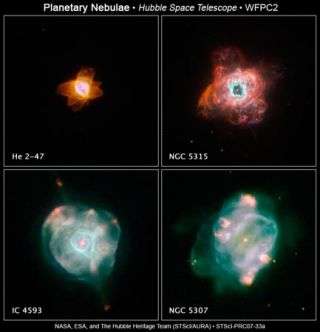
The colorful, intricate shapes in these NASA Hubble Space Telescope images reveal how the glowing gas ejected by dying Sun-like stars evolves dramatically over time.

These gaseous clouds, called planetary nebulae, are created when stars in the last stages of life cast off their outer layers of material into space. Ultraviolet light from the remnant star makes the material glow. Planetary nebulae last for only 10,000 years, a fleeting episode in the 10-billion-year lifespan of Sun-like stars.

The name planetary nebula has nothing to do with planets. They got their name because their round shapes resembled planets when seen through the small telescopes of the eighteenth century.

The Hubble images show the evolution of planetary nebulae, revealing how they expand in size and change temperature over time. A young planetary nebula, such as He 2-47, at top, left, for example, is small and is dominated by relatively cool, glowing nitrogen gas. In the Hubble images, the red, green, and blue colors represent light emitted by nitrogen, hydrogen, and oxygen, respectively.

Over thousands of years, the clouds of gas expand away and the nebulae become larger. Energetic ultraviolet light from the star penetrates more deeply into the gas, causing the hydrogen and oxygen to glow more prominently, as seen near the center of NGC 5315. In the older nebulae, such as IC 4593, at bottom, left, and NGC 5307, at bottom, right, hydrogen and oxygen appear more extended in these regions, and red knots of nitrogen are still visible.

These four nebulae all lie in our Milky Way Galaxy. Their distances from Earth are all roughly the same, about 7,000 light-years. The snapshots were taken with Hubble's Wide Field Planetary Camera 2 in February 2007. Like snowflakes, planetary nebulae show a wide variety of shapes, indicative of the complex processes that occur at the end of stellar life.

He 2-47, at top, left, is dubbed the "starfish" because of its shape. The six lobes of gas and dust, which resemble the legs of a starfish, suggest that He 2-47 puffed off material at least three times in three different directions. Each time, the star fired off a narrow pair of opposite jets of gas. He 2-47 is in the southern constellation Carina.

NGC 5315, the chaotic-looking nebula at top, right, reveals an x-shaped structure. This shape suggests that the star ejected material in two different outbursts in two distinct directions. Each outburst unleashed a pair of diametrically opposed outflows. NGC 5315 lies in the southern constellation Circinus.

IC 4593, at bottom, left, is in the northern constellation Hercules.

NGC 5307, at bottom, right, displays a spiral pattern, which may have been caused by the dying star wobbling as it expelled jets of gas in different directions. NGC 5307 resides in the southern constellation Centaurus.

Source: Space Telescope Science Institute

Explore further: Galaxy's Ring of Fire

add to favorites email to friend print save as pdf

Related Stories

A ghostly green bubble: VLT snaps a planetary nebula

Apr 10, 2013

(Phys.org) —This intriguing new picture from ESO's Very Large Telescope shows the glowing green planetary nebula IC 1295 surrounding a dim and dying star located about 3300 light-years away in the constellation ...

Hubble observes glowing, fiery shells of gas

Mar 04, 2013

(Phys.org) —It may look like something from "The Lord of the Rings," but this fiery swirl is actually a planetary nebula known as ESO 456-67. Set against a backdrop of bright stars, the rust-colored object ...

Hubble sees J 900 masquerading as a double star

Apr 01, 2013

(Phys.org) —The object in this image is Jonckheere 900 or J 900, a planetary nebula—glowing shells of ionized gas pushed out by a dying star. Discovered in the early 1900s by astronomer Robert Jonckheere, ...

Star birth in Cepheus

Apr 01, 2013

(Phys.org) —Watching starbirth isn't easy: tens of millions of years are needed to form a star like our Sun. Much like archeologists who reconstruct ancient cities from shards of debris strewn over time, ...

Soccer balls in interstellar space

Mar 15, 2013

An international team of astronomers led by Masaaki Otsuka (Academia Sinica Institute of Astronomy and Astrophysics or ASIAA) has detected the C60 fullerene (molecules of carbon with 60 atoms arranged in pattern ...

Recommended for you

Galaxy's Ring of Fire

May 18, 2013

Johnny Cash may have preferred this galaxy's burning ring of fire to the one he sang about falling into in his popular song. The "starburst ring" seen at center in red and yellow hues is not the product of ...

4C+29.30: Black hole powered jets plow into galaxy

May 15, 2013

(Phys.org) —This composite image of a galaxy illustrates how the intense gravity of a supermassive black hole can be tapped to generate immense power. The image contains X-ray data from NASA's Chandra X-ray ...

A space-time magnifying glass

May 15, 2013

(Phys.org) —Bright arcs are smeared around the heart of galaxy cluster Abell S1077 in this image taken by the NASA/ESA Hubble space telescope. The arcs are stretched images of distant galaxies distorted ...

User comments : 0

More news stories

Heat-related deaths in Manhattan projected to rise

Residents of Manhattan will not just sweat harder from rising temperatures in the future, says a new study; many may die. Researchers say deaths linked to warming climate may rise some 20 percent by the 2020s, ...

Mice, gerbils perish in Russia space flight

A number of mice and eight gerbils sent into space in a Russian capsule destined to find out how well organisms can withstand extended flights perished during their journey, scientists said Sunday as the ...

Kinks and curves at the nanoscale

One of the basic principles of nanotechnology is that when you make things extremely small—one nanometer is about five atoms wide, 100,000 times smaller than the diameter of a human hair—they are going ...

Honeybees trained in Croatia to find land mines

(AP)—Mirjana Filipovic is still haunted by the land mine blast that killed her boyfriend and blew off her left leg while on a fishing trip nearly a decade ago. It happened in a field that was supposedly ...