Drawing nanoscale features the fast and easy way
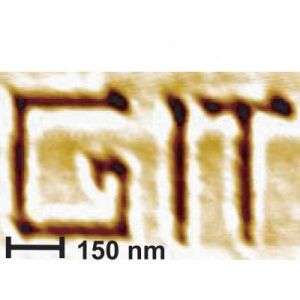
Scientists at the Georgia Institute of Technology have developed a new technique for nanolithography that is extremely fast and capable of being used in a range of environments including air (outside a vacuum) and liquids. Researchers have demonstrated the technique, known as thermochemical nanolithography, as a proof of concept. The technique may allow industry to produce a variety of nanopatterned structures, including nanocircuits, at a speed and scale that could make their manufacture commercially viable.
The research, which has potential applications for fields ranging from the electronics industry to nanofluidics to medicine, appeared earlier this year in the journal Nano Letters.
The technique is surprisingly simple. Using an atomic force microscope (AFM), researchers heat a silicon tip and run it over a thin polymer film. The heat from the tip induces a chemical reaction at the surface of the film. This reaction changes the film’s chemical reactivity and transforms it from a hydrophobic substance to a hydrophilic one that can stick to other molecules. The technique is extremely fast and can write at speeds faster than millimeters per second. That’s orders of magnitude faster than the widely used dip-pen nanolithography (DPN), which routinely clocks at a speed of 0.0001 millimeters per second.
Using the new technique, researchers were able to pattern with dimensions down to 12 nanometers in width in a variety of environments. Other techniques typically require the addition of other chemicals to be transferred to the surface or the presence of strong electric fields. TCNL doesn’t have these requirements and can be used in humid environments outside a vacuum. By using an array of AFM tips developed by IBM, TCNL also has the potential to be massively scalable, allowing users to independently draw features with thousands of tips at a time rather than just one.
“Thermochemical nanolithography is a rapid and versatile technique that puts us much closer to achieving the speeds required for commercial applications,” said Elisa Riedo, assistant professor in Georgia Tech’s School of Physics. “Because we’re not transferring any materials from the AFM tip to the polymer surface (we are only heating it to change its chemical structure) this method can be intrinsically faster than other techniques.”
It’s the heated AFM tips that are one key to the new technique. Designed and fabricated by a group led by William King at the University of Illinois, the tips can reach temperatures hotter than 1,000 degrees Celsius. They can also be repeatedly heated and cooled 1 million times per second.
“The heated tip is the world’s smallest controllable heat source,” said King.
TCNL is also tunable. By varying the amount of heat, the speed and the distance of the tip to the polymer, researchers can introduce topographical changes or modulate the range of chemical changes produced in the material.
“By changing the chemistry of the polymer, we’ve shown that we can selectively attach new substances, like metal ions or dyes to the patterned regions of the film in order to greatly increase the technique’s functionality,” said Seth Marder, professor in Tech’s School of Chemistry and Biochemistry and director of the Center for Organic Photonics and Electronics. Marder’s group developed the thermally switchable polymers used in this study.
“We expect thermochemical nanolithography to be widely adopted because it’s conceptually simple and can be broadly applied,” said Marder. “The scope is limited only by one’s imagination to develop new chemistries and applications.”
For nanolithography to be commercially viable, it must be able to write at high speeds, be used in a variety of environments and write on a variety of materials. While the technique demonstrated here doesn’t yet allow writing at the centimeters per second rate that would be ideal, it does put researchers much closer to the goal than previous techniques. Once perfected, nanolithography could be used to draw nanocircuits for the electronics industry, create nanochannels for nanofluidics devices or be adapted for drug delivery or biosensing technologies.
Source: Georgia Institute of Technology


