Cassini Prepares to Fly by Walnut-Shaped Moon
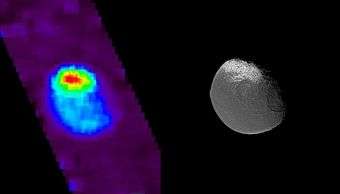
Cassini will make its only close flyby of Saturn's odd, two-toned, walnut-shaped moon Iapetus on Sept. 10, 2007, at about 1,640 kilometers (1,000 miles) from the surface.
This flyby will be 100 times closer than Cassini's 2004 encounter, and will be the last time the spacecraft will aim its instruments at this moon.
Iapetus (pronounced eye-APP-eh-tuss) has a ridge of surprisingly large mountains -- the so-called "belly-band" -- that lies directly on top of the equator. The moon also has a distinct difference in the brightness of its leading and trailing hemispheres, one as bright as snow and the other dark as tar. The irregular shape, the mountain ridge and Iapetus’ brightness contrast are among the key mysteries scientists are trying to solve.
There are several different ideas on the origin of the dark material. Is it from inside or outside of Iapetus? Is it residue from some other moon or moons? Is it due to impacts by meteoroids or comet debris?
"We are on the search for the brush that may have painted Iapetus's dark side," said Dennis Matson, Cassini project scientist at NASA's Jet Propulsion Laboratory, Pasadena, Calif.
"This dark stuff appears in several places in the Saturn system and might be present not just on Iapetus but many other moons,” said JPL scientist Amanda Hendrix of Cassini’s ultraviolet imaging spectrograph team and lead author of a paper soon to be published in the journal Icarus that explores the possible sources of the Iapetus dark material.
There’s a reddish tint to the Iapetus dark stuff, an important clue in tracing its origin, she said. Saturn's moon Hyperion, which shows evidence of a violent disruption in its past, has a reddish tint, too. "It may be that the event that disrupted Hyperion deposited reddish material onto Iapetus," she said. "Hyperion may be the artist that’s painting Iapetus dark."
Yet another Icarus paper on Iapetus by Dale Cruikshank at NASA's Ames Research Center, Moffett Field, Calif., and colleagues, reports that the dark material on Iapetus and Saturn's small moon Phoebe may be composed of the same complex, prebiotic hydrocarbons that appear to play a fundamental role in the origin of life. These chemicals, called polycyclic aromatic hydrocarbons, exist on objects ranging from backyard barbeques to comets, meteorites and the stardust that forms planets and flows between stars. They are important markers in studies of the origin of life in the universe.
An array of Cassini instruments will home in on Iapetus during the flyby. The full menu of objectives includes plans to: characterize the chemical composition of the surface; look for evidence of a faint atmosphere or erupting gas plumes; and map the nighttime temperature of the surface. This will be the first Cassini flyby of an icy moon, other than Titan, that's close enough and slow enough to perform radar imaging with Cassini's Synthetic Aperture Radar. A large swath of terrain will be covered, including the equatorial ridge and regions of craters and basins. These measurements may provide the height of some of the features.
"What is really neat is that we are doing radar of an icy object for which we actually have pictures," said Steve Ostro, a radar scientist at JPL. Until now, he said, the radar had been used to reveal the surface of cloud-covered Titan. Iapetus’ surface is easily visible. "This will be a lesson on how to interpret radar images on an icy body. With Titan, because of the cloud cover, we don't know what we are looking at much of the time, but for Iapetus we will know very well," he said.
In coming weeks, scientists will be analyzing data from multiple instruments. Some results of that analysis will be presented at a planetary science conference in Orlando, Fla., in mid-October.
Source: JPL, NASA


