FSU researchers developing diagnostic 'lab on a chip'
If you have ever marveled over the orderly process by which cars, buses and other modes of transportation are directed toward their destinations in a big city, you’ll really appreciate the work of one Florida State University chemist.
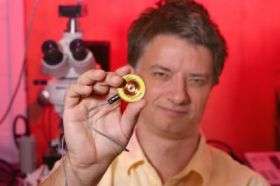
Thomas Fischer, an associate professor of chemistry and biochemistry at FSU, is designing a “smart” traffic system similar to those in major metropolises. A major difference, though, is its size: Fischer’s traffic grid is small enough to fit on a tiny microchip.
Working with an FSU postdoctoral associate, Pietro Tierno, and another colleague, Professor Tom H. Johansen of the University of Oslo in Norway, Fischer has designed a “lab on a chip” -- a small device that, when exposed to very low magnetic fields, might one day be used as a portable tool for quickly diagnosing a variety of human illnesses.
“Currently, a doctor seeking to help a sick patient may take a blood sample and send it out to a laboratory,” Fischer said. “In three or four days, the lab results will come back and the doctor will have a better idea of what ails the patient.
“With the ‘lab on a chip,’ however, it might be possible to take a single drop of the patient’s blood, place it on a small chip, and then be able to provide a very quick, inexpensive and -- most important -- accurate diagnosis.”
Fischer explained that the device would work by exposing the blood sample to very low magnetic field oscillations. In so doing, certain microscopic particles within the sample would be manipulated into “commuting” through an array of magnetic bubbles on the surface of the chip. Observing where various particles align themselves then would enable medical professionals to determine the nature of the patient’s illness.
“Single molecules marking the presence or absence of a disease will be attached to magnetic particles a billion times smaller than a marble,” Fischer said. “The magnetic traffic system then will guide these particles to different positions on the chip depending on their molecular marking.”
A paper describing the research of Fischer, Tierno and Johansen was recently published in the prestigious scientific journal Physical Review Letters. That paper, titled “Localized and Delocalized Motion of Colloidal Particles on a Magnetic Bubble Lattice,” can be accessed at http://link.aps.org/abstract/PRL/v99/e038303.
In addition, Fischer, Tierno and another colleague, Lars Helseth, an assistant professor at Nanyang Technological University in Singapore, have submitted a patent application related to their ‘lab on a chip.’ The application, titled “Digital Transport of Paramagnetic Beads on Magnetic Garnet Films,” states that their goal is to “control the location and movement of molecular objects on a microchip by modulating magnetic domains on the surface of the microchip.”
A company, Siemens Medical Solutions, also has expressed interest in Fischer’s technique. Plans to develop the magnetic chip further in a joint effort are under way.
Much more basic research must be done before such a diagnostic tool is ready for the marketplace. Fischer stressed that science “often is a long, laborious process that can take years to generate results. However, this sort of research is essential if breakthroughs in medicine and the sciences are to occur.”
Source: Florida State University


