Photon-transistors for the supercomputers of the future
Aug 26, 2007
Photon-transistors for the supercomputers of the future
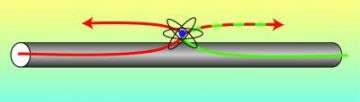
Two photons are sent through a nanowire towards an atom, where they collide, such that one photon (red) transfers its information to the other photon. Credit: Anders Søndberg Sørensen, associate professor, University of Copenhagen

Scientist from the Niels Bohr Institute at University of Copenhagen and from Harvard University have worked out a new theory which describe how the necessary transistors for the quantum computers of the future may be created. The research has just been published in the scientific journal Nature Physics.

Researchers dream of quantum computers. Incredibly fast super computers which can solve such extremely complicated tasks that it will revolutionise the application possibilities. But there are some serious difficulties. One of them is the transistors, which are the systems that process the signals.

Today the signal is an electrical current. For a quantum computer the signal can be an optical one, and it works using a single photon which is the smallest component of light.

“To work, the photons have to meet and “talk”, and the photons very rarely interact together” says Anders Søndberg Sørensen who is a Quantum Physicist at the Niels Bohr Institute at Copenhagen University. He explains that light does not function like in Star Wars, where the people fight with light sabres and can cross swords with the light. That is pure fiction and can’t happen. When two rays of light meet and cross, the two lights go right through each other. That is called linear optics.

What he wants to do with the light is non-linear optics. That means that the photons in the light collide with each other and can affect each other. This is very difficult to do in practice. Photons are so small that one could never hit one with the other. Unless one can control them – and it is this Anders Sørensen has developed a theory about.

Light collisions at the quantum level

Instead of shooting two photons at each other from different directions and trying to get them to hit each other, he wants to use an atom as an intermediary. The atom can only absorb one photon (such are the laws of physics). If you now direct two photons towards the atom it happens that they will collide on the atom. It is exactly what he wants.

The atom is however very small and difficult to hit. So the photons have to be focussed very precisely. In a previous experiment researchers had discovered that microwaves could be focussed on an atom via a superconducting nano-wire. They got the idea that the same could happen with visible light.

The theoretical model shows that it works. The atom is brought close to the nanowire. Two photons are sent towards the atom and when they hit it an interaction occurs between them, where one imparts information to the other. The information is sent in bits which are either a one or zero digit, and the order of digits produces the message. (Today we can send information via an optic cable and each bit is made up of millions of photons.) In quantum optics each bit is just one photon. The photon has now received its message and the signal continues on its way. It is a step on the way to building a photon-transistor for a quantum computer.

Source: University of Copenhagen

Explore further: Breakthrough calls time on bootleg booze

add to favorites email to friend print save as pdf

Related Stories

Photonic quantum computers: A brighter future than ever

May 13, 2013

(Phys.org) —Harnessing the unique features of the quantum world promises a dramatic speed-up in information processing as compared to the fastest classical machines. Scientists from the Group of Philip ...

New principle may help explain why nature is quantum

May 14, 2013

Like small children, scientists are always asking the question 'why?'. One question they've yet to answer is why nature picked quantum physics, in all its weird glory, as a sensible way to behave. Researchers ...

Creating time crystals with a rotating ion ring

May 03, 2013

(Phys.org) —There has been a lot of talk recently about the possibility of building what has come to be known as a time crystal. In February 2012, Frank Wilczek originally proposed the idea that under certain conditions, physical structure ...

Recommended for you

Breakthrough calls time on bootleg booze

18 hours ago

(Phys.org) —Using a laser, the St Andrews scientists can now carry out detailed analysis of a spirit sample no bigger than a teardrop and can even confirm whether it is toxic or not. It's hoped the testing ...

Bringing life into focus

May 17, 2013

Spinning-disk confocal microscopy is an optical imaging technique that can be used to generate detailed three-dimensional fluorescence images of living cells and their contents. Although a powerful tool for ...

World's smallest droplet

May 17, 2013

(Phys.org) —Physicists may have created the smallest drops of liquid ever made in the lab. That possibility has been raised by the results of a recent experiment conducted by Vanderbilt physicist Julia Velkovska and her ...

User comments : 0

More news stories

Lab sets a new record for creating heralded photons

(Phys.org) —Entanglement, by general consensus of physicists, is the weirdest part of quantum science. To say that two particles, A and B, are entangled means that they are actually two parts of an inseparable ...

Competition in the quantum world

Innsbruck physicists led by Rainer Blatt and Peter Zoller experimentally gained a deep insight into the nature of quantum mechanical phase transitions. They are the first scientists that simulated the competition ...

Breakthrough calls time on bootleg booze

(Phys.org) —Using a laser, the St Andrews scientists can now carry out detailed analysis of a spirit sample no bigger than a teardrop and can even confirm whether it is toxic or not. It's hoped the testing ...

New principle may help explain why nature is quantum

Like small children, scientists are always asking the question 'why?'. One question they've yet to answer is why nature picked quantum physics, in all its weird glory, as a sensible way to behave. Researchers ...

Child maltreatment increases risk of adult obesity

Children who have suffered maltreatment are 36% more likely to be obese in adulthood compared to non-maltreated children, according to a new study by King's College London. The authors estimate that the prevention or effective ...

New immune system discovered

(Medical Xpress)—A research team, led by Jeremy Barr, a biology post-doctoral fellow, unveils a new immune system that protects humans and animals from infection.