SMART-1 diagnoses wrinkles and excess weight on the Moon
Aug 22, 2007
SMART-1 diagnoses wrinkles and excess weight on the Moon
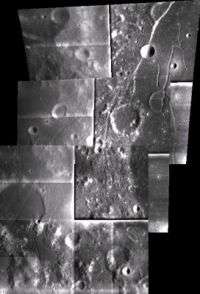
This is a SMART-1 AMIE image mosaic of the edge of Mare Humorum. It shows basalt deposits to the right and graben, or elongated, trench-like erosional fault structures, around the basin. The images were taken from a distance of 1070 km, centred at 46° West and 27° South. The overall image field measures 200 x 130 km. Credits: ESA/Space-X (Space Exploration Institute)

Owing to SMART-1’s high resolution and favourable illumination conditions during the satellite’s scientific operations, data from Europe’s lunar orbiter is helping put together a story linking geological and volcanic activity on the Moon.

The combination of high-resolution data from SMART-1’s AMIE micro-camera and data from the US Clementine mission is helping scientists determine the tectonics of the Moon’s giant basins and the history of volcanic flooding of mid-sized craters, inside and around the lunar basins.

“Thanks to low-elevation solar illumination on these high-resolution images”, says SMART-1 Project Scientist Bernard Foing, “it is now possible to study fine, small-scale geological features that went undetected earlier.”

The study provides new information on the thermal and tectonic history of the Moon and the processes following the formation of the large basins. There are approximately 50 recognizable lunar basins more than 300 km in diameter. They are believed to be created by the impact of asteroids or comets during the Lunar Late Heavy Bombardment period, 350-750 million years after the formation of the Moon. Some of these basins (mostly on the near side) were then filled in by lava originating from volcanic activity.

Combining information from SMART-1 and Clementine makes it possible to assess the link between fine geological structures, identified for the first time with AMIE’s high resolution, and the chemical composition of the study area. These fine geological structures form due to local mascon (mass concentration) or because of the thermal effects in the area related to volcanic activity. This deforms the crust giving it the appearance of being ‘overweight’ or ‘wrinkled’.

“Lunar crust is like a fragile skin, wrinkled due to local mass concentration or its thermal history”, says Bernard Foing, “as doctors, we searched for these skin-imprints but some may be masked underneath the last layers of basalt.”

Source: ESA

Explore further: Dark, massive asteroid to fly by Earth on May 31

add to favorites email to friend print save as pdf

Related Stories

Mercury's surprising core and landscape curiosities

Mar 21, 2012

(PhysOrg.com) -- On March 17, the tiny MESSENGER spacecraft completed its primary mission to orbit and observe the planet Mercury for one Earth-year. The bounty of surprises from the mission has completely ...

Lunar scientists shed light on Moon's impact history

Feb 28, 2012

(PhysOrg.com) -- A team of researchers from the NASA Lunar Science Institute (NLSI) at NASA Ames Research Center, Moffett Field, Calif., have discovered that debris that caused a "lunar cataclysm" on the moon ...

GRAIL returns first video from moon's far side

Feb 01, 2012

(PhysOrg.com) -- A camera aboard one of NASA's twin Gravity Recovery And Interior Laboratory (GRAIL) lunar spacecraft has returned its first unique view of the far side of the moon. MoonKAM, or Moon Knowledge ...

Recommended for you

Dark, massive asteroid to fly by Earth on May 31

May 24, 2013

It's 1.7 miles long. Its surface is covered in a sticky black substance similar to the gunk at the bottom of a barbecue. If it impacted Earth it would probably result in global extinction. Good thing it is ...

Research team explains 'Lazarus' comets

May 24, 2013

Astronomers from the University of Antioquia have discovered a graveyard of comets. These once-dormant comets, dubbed by astronomers as "The Lazarus comets," are now rejuvenated.

NASA ships sensors for seafaring satellite to France

May 24, 2013

(Phys.org) —Three NASA-built instruments that are integral components of the next in a series of U.S./European ocean altimetry satellites have arrived in France for integration with their spacecraft in ...

Trip into space with DiCaprio costs $1.55m

May 24, 2013

Leonardo DiCaprio is going to get closer to stars of a different kind as he heads into space aboard the Virgin Galactic, and a well-heeled bidder at the Cannes Film Festival has paid 1.2 million euros (1.5 million) to be ...

User comments : 0

More news stories

Galaxies fed by funnels of fuel

(Phys.org) —Computer simulations of galaxies growing over billions of years have revealed a likely scenario for how they feed: a cosmic version of swirly straws.

Century-old science helps confirm global warming

(Phys.org) —Ocean measurements taken more than 135 years ago during the scientific expedition of HMS Challenger have provided further confirmation of human-produced global warming over the past century.