Moving to the rhythm of the Sun
Aug 17, 2007
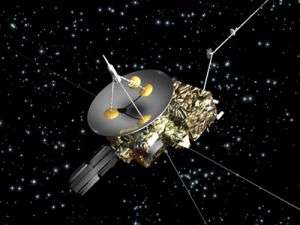
Ulysses spacecraft
This artist's impression shows the ESA/NASA Ulysses spacecraft. Launched in 1990, the European-built spacecraft visits both polar regions once every 6.2 years as it circles the Sun in an orbit that is almost perpendicular to the ecliptic, the plane in which Earth and the planets move. Credits: ESA

Scientists from the Ulysses mission have proven that sounds generated deep inside the Sun cause the Earth to shake and vibrate in sympathy. They have found that Earth’s magnetic field, atmosphere and terrestrial systems, all take part in this cosmic sing-along.

David Thomson and Louis Lanzerotti are team members of the HISCALE experiment on board Ulysses, a joint mission between ESA and NASA. Together with colleagues Frank Vernon, Marc Lessard and Lindsay Smith, they present evidence that proves that Earth moves to the rhythm of the Sun. They show that distinct, isolated tones, predicted to be generated by pressure and gravity waves in the Sun, manage to reach Earth and are detectable in our environment.

Thomson and colleagues have discovered these tones in seismic data and have found them in Earth’s magnetic field and atmosphere, and even in voltages induced on ocean cables, along with a wide variety of terrestrial systems. Although these tones are all around us, it would not be possible for us to hear them, even if we listened very closely.

According to Thomson, data from Ulysses provided an important clue as to how these sounds generated deep inside the Sun reach the Earth.

His team also present new evidence for these tones in various terrestrial systems here on Earth. They also provide an explanation for the mechanism by which these tones, originating from deep inside the solar interior manage to make their way to Earth, and pervade our environment.

Source: ESA

Explore further: Collisions of coronal mass ejections can be super-elastic

add to favorites email to friend print save as pdf

Related Stories

Fire burn and cauldron bubble in Canis Major

Oct 30, 2012

The cosmic cauldron has brewed up a Halloween trick in the form of a ghostly face that glows in X-rays, as seen by ESA's XMM-Newton space telescope. The eerie entity is a bubble bursting with the fiery stellar ...

NASA braces for 'terror' in Mars landing

Aug 02, 2012

The biggest, baddest space rover ever built for exploring an alien planet is nearing its August 6 landing on Mars, and the US space agency is anxious for success despite huge risks.

Image: Station crew sees 'night-shining' clouds

Jun 27, 2012

(Phys.org) -- In both the Earth's Northern and Southern Hemispheres polar mesospheric clouds are at the peak of their visibility, during their respective late spring and early summer seasons. Visible from ...

Massive ice avalanches on Iapetus

Mar 22, 2012

We've seen avalanches on Mars, but now scientists have found avalanches taking place on an unlikely place in our solar system: Saturn’s walnut-shaped, two-toned moon Iapetus. And these aren’t just ...

Recommended for you

Forecast for Titan: Wild weather could be ahead

15 hours ago

(Phys.org) —Saturn's moon Titan might be in for some wild weather as it heads into its spring and summer, if two new models are correct. Scientists think that as the seasons change in Titan's northern hemisphere, ...

SDO observes mid-level solar flare

15 hours ago

UPDATE 16:30 p.m. EDT: The M7-class flare was also associated with a coronal mass ejection or CME, another solar phenomenon that can send billions of tons of particles into space. While this CME was not Ea ...

NASA's IRIS mission readies for a new challenge

May 22, 2013

(Phys.org) —The time draws near. NASA is getting ready to launch a new mission, a mission to observe a largely unexplored region of the solar atmosphere that powers its dynamic million-degree outer atmosphere and drives ...

User comments : 0

More news stories

Very Large Telescope celebrates 15 years of success

(Phys.org) —With this new view of a spectacular stellar nursery ESO is celebrating 15 years of the Very Large Telescope—the world's most advanced optical instrument. This picture reveals thick clumps ...

Be prepared for weather extremes

Unsettled weather is an Iowa mainstay, and so is Inside's annual reminder of the university's severe weather safety and preparedness guidelines—for storms, extreme heat, flooding and more.

Weird science: Crystals melt when they're cooled

(Phys.org) —Growing thin films out of nanoparticles in ordered, crystalline sheets, to make anything from microelectronic components to solar cells, would be a boon for materials researchers, but the physics ...

Unlocking secrets of cell reproduction

Research published in Open Biology today identifies, for the first time, nearly all the genes required for reproduction of a cell in a living organism.