Clearing Electron Clouds
Aug 02, 2007
Clearing Electron Clouds
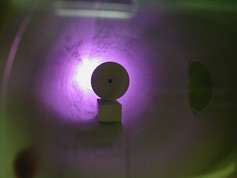
The circular device inside this accelerator structure coats the structure with titanium nitride to keep electron clouds in check.

Clouds might be welcome during a drought, but you definitely don't want them in your beam pipes. Researchers around the world are working out how to keep a section of the proposed International Linear Collider—the positron damping ring—clear of electron clouds.

In curved sections of accelerators, such as a damping ring, the beam throws off synchrotron radiation that plows into the beam pipe walls, kicking up electrons embedded in the wall. The newly freed electrons get pulled along with the next bunch of positrons in the beam, but then some hit the wall, freeing so-called secondary electrons. Soon a cloud of electrons clogs up the beam pipe.

"When the beam passes through a cloud, it's like a plane passing through turbulence," said Mauro Pivi, of SLAC's ILC Accelerator Design group.

One way to suppress clouds is to choose beam pipe materials that let fewer electrons escape. Pivi, Robert Kirby of the Surface & Materials Science Department, and their colleagues are measuring the "secondary electron yield," looking for surface materials that limit the number secondary electrons produced, ideally to less than one for every electron that strikes the wall.

"If the yield is below one, the cloud doesn't have time to form," Pivi said.

Researchers at SLAC have tested the yield of a coating material called titanium nitride, already used in parts of the PEP-II accelerator. Recent work done at SLAC and KEK in Japan has shown that the yield decreases after the material has been exposed to the passing beam.

Researchers used an electron gun located in Building 40 to measure a yield of 1.8 secondary electrons produced for every incoming electron. Then they took a sample of the material to the PEP-II tunnel. Using a transfer line, they inserted the sample inside the vacuum chamber, plugging a hole in the beam pipe wall. After weeks of exposure to the accelerator's synchrotron radiation, which scours contamination off the walls, the sample of titanium nitride had a yield below one.

While promising, this avenue of research is just one of the paths being explored in the quest to keep the positron damping ring clear.

Source: by Heather Rock Woods, SLAC Today

Explore further: Error sought & found: State-of-the-art measurement technique optimised

add to favorites email to friend print save as pdf

Related Stories

Making quantum encryption practical

May 21, 2013

One of the many promising applications of quantum mechanics in the information sciences is quantum key distribution (QKD), in which the counterintuitive behavior of quantum particles guarantees that no one can eavesdrop on ...

Recommended for you

Engineers pioneer flat spray-on optical lens

8 hours ago

A University of British Columbia engineer and a team of U.S. researchers have made a breakthrough utilizing spray-on technology that could revolutionize the way optical lenses are made and used.

How do cold ions slide

10 hours ago

Things not always run smoothly. It may happen, actually, that when an object slides on another, the advancement may occur through a 'stop and go' series in the characteristic manner which scientists call ...

User comments : 0

More news stories

A quantum simulator for magnetic materials

Physicists understand perfectly well why a fridge magnet sticks to certain metallic surfaces. But there are more exotic forms of magnetism whose properties remain unclear, despite decades of intense research. ...

Engineers pioneer flat spray-on optical lens

A University of British Columbia engineer and a team of U.S. researchers have made a breakthrough utilizing spray-on technology that could revolutionize the way optical lenses are made and used.

Researchers forward quest for quantum computing

Research teams from UW-Milwaukee and the University of York investigating the properties of ultra-thin films of new materials are helping bring quantum computing one step closer to reality.

How do cold ions slide

Things not always run smoothly. It may happen, actually, that when an object slides on another, the advancement may occur through a 'stop and go' series in the characteristic manner which scientists call ...

Future doctors unaware of their obesity bias

Two out of five medical students have an unconscious bias against obese people, according to a new study by researchers at Wake Forest Baptist Medical Center. The study is published online ahead of print in the Journal of ...

WHO: Scientific red tape mars efforts vs. virus

International efforts to combat a new pneumonia-like virus that has now killed 22 people are being slowed by unclear rules and competition for the potentially profitable rights to disease samples, the head ...