Cassini Finds Possible Origin of One of Saturn's Rings
Aug 02, 2007
Cassini Finds Possible Origin of One of Saturn's Rings
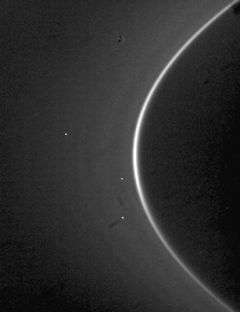
This image shows the arc orbits at a distance of 167,496 kilometres. It is about 250 kilometres wide in radius and subtends less than 60 degrees of orbital longitude. The classical position of the G ring is about 172,600 kilometres from Saturn, and the arc blends smoothly into this region. Scientists suspect that bodies trapped in this remarkably bright feature may be the source of the G ring material, driven outward from the arc by electromagnetic forces in the Saturn system. The arc itself is likely held in place by gravitational resonances with Mimas of the type that anchor the famed arcs in Neptune's rings. There is an obvious narrow dark gap in the G ring beyond the arc. This feature is close to yet another resonance with Mimas, but no arcs are present at this locale. Credits: NASA - JPL - Space Science Institute

Cassini scientists may have identified the source of one of Saturn's more mysterious rings. Saturn's G ring likely is produced by relatively large, icy particles that reside within a bright arc on the ring's inner edge.

The particles are confined within the arc by gravitational effects from Saturn's moon Mimas. Micrometeoroids collide with the particles, releasing smaller, dust-sized particles that brighten the arc. The plasma in the giant planet's magnetic field sweeps through this arc continually, dragging out the fine particles, which create the G ring.

The finding is evidence of the complex interaction between Saturn's moons, rings and magnetosphere. Studying this interaction is one of Cassini's objectives. The study is in the Aug. 2 issue of the journal Science and was based on observations made by multiple Cassini instruments in 2004 and 2005.

"Distant pictures from the cameras tell us where the arc is and how it moves, while plasma and dust measurements taken near the G ring tell us how much material is there," said Matthew Hedman, a Cassini imaging team associate at Cornell University in Ithaca, N.Y., and lead author on the Science paper.

Saturn's rings are an enormous, complex structure, and their origin is a mystery. The rings are labeled in the order they were discovered. From the planet outward, they are D, C, B, A, F, G and E. The main rings -- A, B and C-from edge-to-edge, would fit neatly in the distance between Earth and the moon. The most transparent rings are D -- interior to C -- and F, E and G, outside the main rings.

Unlike Saturn's other dusty rings, such as the E and F rings, the G ring is not associated closely with moons that either could supply material directly to it -- as Enceladus does for the E ring -- or sculpt and perturb its ring particles -- as Prometheus and Pandora do for the F ring. The location of the G ring continued to defy explanation, until now.

Cassini images show that the bright arc within the G ring extends one-sixth of the way around Saturn and is about 155 miles wide, much narrower than the full 3,700-mile width of the G ring. The arc has been observed several times since Cassini's 2004 arrival at the ringed planet and thus appears to be a long-lived feature. A gravitational disturbance caused by the moon Mimas exists near the arc.

As part of their study, Hedman and colleagues conducted computer simulations that showed the gravitational disturbance of Mimas could indeed produce such a structure in Saturn's G ring. The only other places in the solar system where such disturbances are known to exist are in the ring arcs of Neptune.

Cassini's magnetospheric imaging instrument detected depletions in charged particles near the arc in 2005. According to the scientists, unseen mass in the arc must be absorbing the particles. "The small dust grains that the Cassini camera sees are not enough to absorb energetic electrons," said Elias Roussos of the Max-Planck-Institute for Solar System Research, Germany, and member of the magnetospheric imaging team. "This tells us that a lot more mass is distributed within the arc."

The researchers concluded that there is a population of larger, as-yet-unseen bodies hiding in the arc, ranging in size from that of peas to small boulders. The total mass of all these bodies is equivalent to that of a 328-foot-wide, ice-rich small moon.

Joe Burns, a co-author of the paper from Cornell University and a member of the imaging team, said, "We'll have a super opportunity to spot the G ring's source bodies when Cassini flies about 600 miles from the arc 18 months from now."

Source: NASA

Explore further: South Africa's new radio telescope reveals giant outbursts from binary star system

add to favorites email to friend print save as pdf

Related Stories

7.1 magnitude earthquake hits Indonesia

Apr 06, 2013

A powerful 7.1 magnitude earthquake hit a remote part of eastern Indonesia on Saturday, causing residents to run outside in panic, but there were no immediate reports of damage or injuries, an official said.

Italian all-sky imager tracks auroral red arcs over Europe

Mar 30, 2013

During geomagnetic storms, stable auroral red (SAR) arcs reach down from polar latitudes, their faint glow stretching equatorward of the traditional auroral oval. Invisible to the naked eye, SAR arcs are an upper atmospheric ...

Quake off Indonesia causes panic in East Timor

Feb 24, 2013

(AP)—An undersea earthquake has rocked eastern Indonesia, causing panic among residents in neighboring East Timor. There were no immediate reports of injuries or damage.

Cassini Images Ring Arcs Among Saturn's Moons

Sep 05, 2008

(PhysOrg.com) -- NASA's Cassini spacecraft has detected a faint, partial ring orbiting with one small moon of Saturn, and has confirmed the presence of another partial ring orbiting with a second moon. This ...

Small tsunami hits Solomons, other warnings ended

Feb 06, 2013

A powerful earthquake off the Solomon Islands on Wednesday generated a tsunami of up to 1.5 meters (about 5 feet) that damaged dozens of homes and left at least four people missing and presumed dead in the South Pacific island ...

Recommended for you

Galaxy's Ring of Fire

1 hour ago

Johnny Cash may have preferred this galaxy's burning ring of fire to the one he sang about falling into in his popular song. The "starburst ring" seen at center in red and yellow hues is not the product of ...

4C+29.30: Black hole powered jets plow into galaxy

May 15, 2013

(Phys.org) —This composite image of a galaxy illustrates how the intense gravity of a supermassive black hole can be tapped to generate immense power. The image contains X-ray data from NASA's Chandra X-ray ...

A space-time magnifying glass

May 15, 2013

(Phys.org) —Bright arcs are smeared around the heart of galaxy cluster Abell S1077 in this image taken by the NASA/ESA Hubble space telescope. The arcs are stretched images of distant galaxies distorted ...

User comments : 0

More news stories

Galaxy's Ring of Fire

Johnny Cash may have preferred this galaxy's burning ring of fire to the one he sang about falling into in his popular song. The "starburst ring" seen at center in red and yellow hues is not the product of ...

Alaska volcano shoots ash 15,000 feet into the air

(AP)—One of Alaska's most restless volcanoes has shot an ash cloud 15,000 feet into the air in an ongoing eruption that has drawn attention from a nearby community but isn't expected to threaten air traffic.

Chinese, Indian airlines face EU pollution fines

Eight Chinese and two Indian airlines face fines of up to several million euros for not paying for their greenhouse gas emissions during flights within the bloc, the European Commission said on Friday.

Morocco to harness the wind in energy hunt

Morocco is ploughing ahead with a programme to boost wind energy production, particularly in the southern Tarfaya region, where Africa's largest wind farm is set to open in 2014.

New case of SARS-like virus in Saudi: ministry

A new case of the deadly coronavirus has been detected in Saudi Arabia where 15 people have already died after contracting it, the health ministry announced on Saturday on its Internet website.