Dawn Rescheduled for September Launch
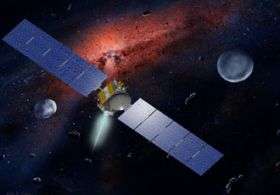
The launch of NASA's Dawn spacecraft, a mission that will explore the two largest objects in the asteroid belt in an effort to answer questions about the formation of our solar system, has been rescheduled to September.
The decision was made Saturday to move the launch to September after careful review by NASA's Science Mission Directorate officials, working with Dawn mission managers, the Dawn principal investigator, and with the concurrence of the NASA Administrator.
Primary reasons for the move were a combination of highly limited launch opportunities for Dawn in July and the potential impact to launch preparations for the upcoming Phoenix Mars Lander mission, set for early August. A September launch for Dawn maintains all of the science mission goals a July launch would have provided.
NASA will hold a news briefing on Monday, July 9, to preview the launch of the Phoenix Mars Lander.
During its nearly decade-long mission, the Dawn mission will study the asteroid Vesta and dwarf planet Ceres, celestial bodies believed to have accreted early in the history of the solar system. The mission will characterize the early solar system and the processes that dominated its formation.
During the earliest epochs of our solar system, the materials in the solar nebula varied with their distance from the sun. As this distance increased, the temperature dropped, with terrestrial bodies forming closer to the sun, and icy bodies forming farther away.
The asteroid Vesta and the recently categorized dwarf planet Ceres have been selected because, while both speak to conditions and processes early in the formation of the solar system, they developed into two different kinds of bodies. Vesta is a dry, differentiated object with a surface that shows signs of resurfacing. It resembles the rocky bodies of the inner solar system, including Earth. Ceres, by contrast, has a primitive surface containing water-bearing minerals, and may possess a weak atmosphere. It appears to have many similarities to the large icy moons of the outer solar system.
By studying both these two distinct bodies with the same complement of instruments on the same spacecraft, the Dawn mission hopes to compare the different evolutionary path each took as well as create a picture of the early solar system overall. Data returned from the Dawn spacecraft could provide opportunities for significant breakthroughs in our knowledge of how the solar system formed.
To carry out its scientific mission, the Dawn spacecraft will carry three science instruments whose data will be used in combination to characterize these bodies. These instruments consist of a visible camera, a visible and infrared mapping spectrometer, and a gamma ray and neutron spectrometer. In addition to these instruments, radiometric and optical navigation data will provide data relating to the gravity field and thus bulk properties and internal structure of the two bodies.
Source: NASA


