Cassini Finds Hydrocarbons on Saturn's Moon Hyperion
Jul 05, 2007
Cassini Finds Hydrocarbons on Saturn's Moon Hyperion
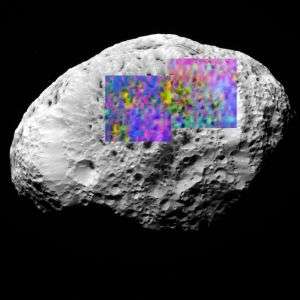
This map shows the composition of a portion of Hyperion's surface. Blue shows the maximum exposure of frozen water, red denotes carbon dioxide ice ("dry ice"), magenta indicates regions of water plus carbon dioxide, yellow is a mix of carbon dioxide and an unidentified material. Image credit: NASA/JPL/University of Arizona/Ames/Space Science Institute

NASA's Cassini spacecraft has revealed for the first time surface details of Saturn's moon Hyperion, including cup-like craters filled with hydrocarbons that may indicate more widespread presence in our solar system of basic chemicals necessary for life.

Hyperion yielded some of its secrets to the battery of instruments aboard Cassini as the spacecraft flew close by in September 2005. Water and carbon dioxide ices were found, as well as dark material that fits the spectral profile of hydrocarbons.

A paper appearing in the July 5 issue of Nature reports details of Hyperion's surface craters and composition observed during this flyby, including keys to understanding the moon's origin and evolution over 4.5 billion years. This is the first time scientists were able to map the surface material on Hyperion.

"Of special interest is the presence on Hyperion of hydrocarbons--combinations of carbon and hydrogen atoms that are found in comets, meteorites, and the dust in our galaxy," said Dale Cruikshank, a planetary scientist at NASA's Ames Research Center, Moffett Field, Calif., and the paper's lead author. "These molecules, when embedded in ice and exposed to ultraviolet light, form new molecules of biological significance. This doesn't mean that we have found life, but it is a further indication that the basic chemistry needed for life is widespread in the universe."

Cassini's ultraviolet imaging spectrograph and visual and infrared mapping spectrometer captured compositional variations in Hyperion's surface. These instruments, capable of mapping mineral and chemical features of the moon, sent back data confirming the presence of frozen water found by earlier ground-based observations, but also discovered solid carbon dioxide (dry ice) mixed in unexpected ways with the ordinary ice. Images of the brightest regions of Hyperion's surface show frozen water that is crystalline in form, like that found on Earth.

"Most of Hyperion's surface ice is a mix of frozen water and organic dust, but carbon dioxide ice is also prominent. The carbon dioxide is not pure, but is somehow chemically attached to other molecules," explained Cruikshank.

Prior spacecraft data from other moons of Saturn, as well as Jupiter's moons Ganymede and Callisto, suggest that the carbon dioxide molecule is "complexed," or attached with other surface material in multiple ways. "We think that ordinary carbon dioxide will evaporate from Saturn's moons over long periods of time," said Cruikshank, "but it appears to be much more stable when it is attached to other molecules."

"The Hyperion flyby was a fine example of Cassini's multi-wavelength capabilities. In this first-ever ultraviolet observation of Hyperion, the detection of water ice tells us about compositional differences of this bizarre body," said Amanda Hendrix, Cassini scientist on the ultraviolet imaging spectrograph at NASA's Jet Propulsion Laboratory, Pasadena, Calif.

Hyperion, Saturn's eighth largest moon, has a chaotic spin and orbits Saturn every 21 days. The July 5 issue of Nature also includes new findings from the imaging team about Hyperion's strange, spongy-looking appearance. Details are online at: ciclops.org/view.php?id=3303 .

Source: NASA

Explore further: Field tests in Mojave Desert pave way for human exploration of small bodies

add to favorites email to friend print save as pdf

Related Stories

Geologists study mystery of 'eternal flames'

May 09, 2013

"Eternal flames" fueled by hydrocarbon gas could shine a light on the presence of natural gas in underground rock layers and conditions that let it seep to the surface, according to research by geologists ...

Electrolysis method described for making 'green' iron

May 08, 2013

Anyone who has seen pictures of the giant, red-hot cauldrons in which steel is made—fed by vast amounts of carbon, and belching flame and smoke—would not be surprised to learn that steelmaking is one of the world's leading ...

Weather forecasts on Mars

May 08, 2013

(Phys.org) —In the north of the red planet snowfalls occur with great regularity. Expeditions of Mars rovers into this region could therefore be easily planned.

Recommended for you

Mars rover Opportunity examines clay clues in rock

11 hours ago

(Phys.org) —NASA's senior Mars rover, Opportunity, is driving to a new study area after a dramatic finish to 20 months on "Cape York" with examination of a rock intensely altered by water.

NASA's STEREO detects a CME from the sun

May 17, 2013

On 5:24 a.m. EDT on May 17, 2013, the sun erupted with an Earth-directed coronal mass ejection or CME, a solar phenomenon that can send billions of tons of solar particles into space that can reach Earth ...

Nine-year-old Mars rover passes 40-year-old record

May 17, 2013

While Apollo 17 astronauts Eugene Cernan and Harrison Schmitt visited Earth's moon for three days in December 1972, they drove their mission's Lunar Roving Vehicle 19.3 nautical miles (22.210 statute miles ...

Bright explosion on the Moon

May 17, 2013

For the past 8 years, NASA astronomers have been monitoring the Moon for signs of explosions caused by meteoroids hitting the lunar surface. "Lunar meteor showers" have turned out to be more common than anyone ...

User comments : 0

More news stories

Galaxy's Ring of Fire

Johnny Cash may have preferred this galaxy's burning ring of fire to the one he sang about falling into in his popular song. The "starburst ring" seen at center in red and yellow hues is not the product of ...

Alaska volcano shoots ash 15,000 feet into the air

(AP)—One of Alaska's most restless volcanoes has shot an ash cloud 15,000 feet into the air in an ongoing eruption that has drawn attention from a nearby community but isn't expected to threaten air traffic.

Chinese, Indian airlines face EU pollution fines

Eight Chinese and two Indian airlines face fines of up to several million euros for not paying for their greenhouse gas emissions during flights within the bloc, the European Commission said on Friday.

US seizes Bitcoin operator accounts

US authorities seized the accounts of a Bitcoin digital currency exchange operator, claiming it was functioning as an "unlicensed money service business," court documents showed Friday.

Morocco to harness the wind in energy hunt

Morocco is ploughing ahead with a programme to boost wind energy production, particularly in the southern Tarfaya region, where Africa's largest wind farm is set to open in 2014.